
Quick Answer: Shiv Nadar, founder of HCL Technologies, is the individual most billionaire trackers identify as Delhi’s richest man in 2026, with an estimated net worth of roughly $25 billion to $33 billion depending on the source and date used. Telecom entrepreneur Sunil Mittal, also Delhi-based, is close enough in wealth that the two effectively trade places depending on which list, and which day, you check.
Delhi holds two of India’s largest individual fortunes at once: Shiv Nadar of HCL Technologies and Sunil Mittal of Bharti Enterprises. Rather than open with a straight biography, this guide leads with what most searchers actually want to know: who holds the title, why, how that figure is calculated, and why it keeps changing.
It then compares Nadar’s wealth with Delhi’s other business leaders. His background, leadership history, philanthropy, and the city’s luxury real estate market, which this wealth has helped shape, follow after.
Key Takeaways
- Shiv Nadar is generally cited as Delhi’s richest man, with Forbes placing his individual net worth at roughly $25 billion to $33 billion depending on the date and list used.
- Almost all of that wealth is unrealized value in a single listed company, HCL Technologies, held through family promoter holdings rather than cash or diversified assets.
- Sunil Mittal of Bharti Enterprises is close enough in wealth that Forbes’ own October 2025 list actually placed him marginally ahead of Nadar, $34.2 billion to $33.2 billion.
- In March 2025, Nadar transferred a large block of his HCLTech promoter holdings to his daughter, Roshni Nadar Malhotra, who is now the company’s majority shareholder and, on Hurun’s 2026 list, ranks above her father.
Quick Facts About Shiv Nadar
| Attribute | Details |
|---|---|
| Full Name | Shiv Nadar |
| Born | 14 July 1945, Moolaipozhi village, Thoothukudi district, Tamil Nadu |
| Known For | Founder of HCL Technologies; a pioneer of India’s IT services industry |
| Company | HCL Technologies (HCLTech) |
| Industry | Information technology and software services |
| Estimated Net Worth | Approximately $25 billion to $33 billion (an estimate; see net worth mechanics below) |
| Headquarters | Noida, Uttar Pradesh, in the Delhi National Capital Region |
| Current Role | Founder, Chairman Emeritus and Strategic Advisor |
| Nationality | Indian |
| Residence | Delhi |
| Major Philanthropic Initiative | Shiv Nadar Foundation, established 1994 |
Why Shiv Nadar Is Considered Delhi’s Richest Man
Shiv Nadar’s claim to the title rests on scale, not a technicality. Almost the entirety of his wealth sits in HCL Technologies, a company with a market capitalization built over five decades. His family’s promoter stake in it is large enough that even a fractional percentage of the company’s value runs into the billions of dollars.
That single fact, concentrated founder ownership in a large-cap, listed company, is what separates his wealth from most other forms of high income in India. It is why his fortune moves in billions rather than crores even in a routine week of stock trading.
A Closer Race Than It Looks
The title is also closer than a casual reading suggests. On Forbes’ own “India’s 100 Richest 2025” list, published in October 2025, Bharti Enterprises’ Sunil Mittal and family were ranked fourth nationally at $34.2 billion, marginally ahead of Nadar’s fifth-place $33.2 billion.
Both fortunes are concentrated in a single flagship company, both men are Delhi-based, and both figures move by billions of dollars over the course of a year. Shiv Nadar remains the name most publications and wealth trackers converge on as “Delhi’s richest man,” largely on the strength of long-standing association and the consistency with which Forbes’ real-time tool has tracked him individually.
But the actual numeric gap at the top is thin enough that Nadar and Mittal are better described as running a close, ongoing contest than as having a settled, permanent order between them.
The Succession Complication
A second complication has emerged more recently. In March 2025, Nadar transferred a substantial block of his HCLTech promoter-company shares, reportedly around 47 percent of his holding in those entities, to his daughter, Roshni Nadar Malhotra, making her the company’s majority shareholder.
Forbes continues to track Shiv Nadar individually, which is why he still tops most “richest man” style queries. Hurun’s Global Rich List 2026, however, now lists Roshni Nadar Malhotra, not her father, as the family’s representative, ranked third richest in India.
Both are correct answers to slightly different questions. That gap between two equally defensible answers is the clearest evidence that a net worth ranking is only ever as meaningful as the methodology behind it, which is exactly what the next section unpacks.
How Is Shiv Nadar’s Net Worth Actually Calculated?
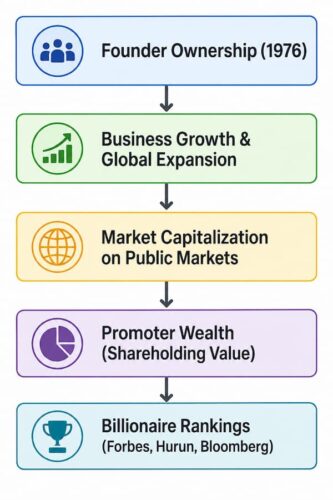
Most readers encounter a net worth figure without ever seeing how it was produced. For a founder like Shiv Nadar, whose fortune is not cash in a bank account but a large ownership stake in a publicly traded company, the number is really an estimate built from several moving parts, shown in simplified form below.
Wealth Creation Flow
Promoter Holdings, Not Personal Savings
In Indian stock market terminology, a “promoter holding” is the stake a company’s founders and their families retain and disclose in exchange filings, distinct from the public float held by ordinary investors. Nadar and his family control HCL Technologies through exactly this kind of promoter holding, held mainly through private investment and holding companies rather than as shares in his own name.
This is an arrangement Forbes described in its coverage of the March 2025 transfer, and one commonly, if informally, called a family office structure among ultra-high-net-worth families.
Market Capitalization Drives the Number
HCL Technologies is a listed, large-cap company on India’s two main exchanges, the National Stock Exchange (NSE) and the Bombay Stock Exchange (BSE). Its total market capitalization sets the pool of value the family’s roughly 57 percent promoter stake draws from.
When HCLTech’s share price rises, the family’s paper wealth rises proportionally without a single share changing hands. This equity appreciation, not new income, is the core mechanic behind nearly all of Nadar’s wealth growth.
Promoter shareholders also receive genuine cash income through dividends each year. HCLTech declared a full-year dividend of ₹60 per share for FY26, real, recurring income layered on top of the shareholding’s paper value, though the family’s exact personal dividend receipts are not separately disclosed.
Different Trackers, Different Methods
Forbes’ real-time billionaires tool recalculates net worth continuously against the day’s closing share price, which is why it can show a different figure every single day; it placed Nadar at $25.7 billion in early July 2026. Forbes’ separate, annual “India’s 100 Richest” list uses a fixed valuation date each year and listed him at $33.2 billion as of October 2025.
Hurun uses its own valuation date, converts rupee holdings into dollars at that day’s exchange rate, and currently attributes the family’s HCLTech wealth to Roshni Nadar Malhotra rather than Shiv Nadar individually, following the 2025 transfer.
Bloomberg’s Billionaires Index runs its own real-time model and has historically attributed all family-held shares to the patriarch to reflect his historical strategic control, a convention that does not automatically update the moment shares change hands internally.
None of these methodologies is wrong; each is answering the question on a different day, with different currency assumptions, and different rules for attributing shared family wealth to one name.
Currency adds a further layer of movement of its own. Because the underlying wealth is held in rupees but almost always reported in dollars, a weaker or stronger rupee can shift the headline figure even on a day when HCLTech’s share price does not move at all.
Wealth and Succession Timeline
| Year | Event |
|---|---|
| 1976 | Nadar and five colleagues found HCL; the Uttar Pradesh government takes an early equity stake |
| 1991 | Software arm spun off as HCL Technologies, coinciding with India’s economic liberalization |
| 1999 | HCL Technologies lists on India’s stock exchanges |
| 2007 | Steps down as CEO |
| 2014 | Net worth estimated at $8.6 billion (Forbes) |
| 2015 | Net worth rises to $13.7 billion (Forbes) |
| 2020 | Steps down as Chairman; Roshni Nadar Malhotra becomes Chairperson; net worth around $26 billion (Forbes) |
| 2021 | Steps down as Managing Director; net worth reaches $31 billion by October (Forbes) |
| 2025 | Transfers majority shareholding to Roshni Nadar Malhotra in March; net worth at $33.2 billion by October (Forbes) |
| 2026 | Real-time net worth at $25.7 billion in July, as Chairman Emeritus and Strategic Advisor |
Three things stand out in that combined trajectory. The steep climb between 2014 and 2021 tracks HCL Technologies’ own growth into a global services company, not a change in how much of it Nadar owned.
The leadership handover between 2020 and 2025, first the chairperson role, then majority shareholding, did not interrupt that growth. That continuity is itself evidence the succession was engineered to preserve the underlying business rather than unsettle it.
And the dip visible by mid-2026 is not the business shrinking. It reflects ordinary share price movement layered on top of the mechanical fact that a meaningful slice of wealth Forbes once attributed to Shiv Nadar personally has, since March 2025, been legally reassigned to his daughter. Rankings move for reasons that have little to do with whether the underlying company is actually doing better or worse.
Why Delhi Is Home to Some of India’s Wealthiest Business Families
Shiv Nadar and Sunil Mittal are not outliers in Delhi so much as the most visible examples of a broader pattern. As India’s political capital, Delhi and its wider National Capital Region sit close to the regulatory bodies, ministries and licensing authorities that shape large-scale infrastructure, telecom and technology businesses.
That proximity has historically mattered for capital-intensive sectors built on spectrum licenses, land allocations and government contracts. Bharti Airtel’s original mobile licenses and HCL’s own early land arrangement with the Uttar Pradesh government both trace back to exactly this kind of policy adjacency.
The wider NCR, spanning Delhi, Gurugram and Noida, is also simply where a large share of India’s corporate headquarters sit, across telecom, IT services, aviation, consumer goods and real estate. Family-owned businesses that started in Delhi’s traditional trading clusters, like Dabur’s Burman family, now sit alongside newer-economy fortunes built in telecom and technology, like Mittal’s and Nadar’s.
This concentration reflects Delhi’s role as India’s political and corporate decision-making center more than any single industry advantage. That is precisely why the city’s wealthiest residents span technology, telecom, aviation and consumer goods rather than clustering around one sector the way Bengaluru’s wealth clusters around technology or Hyderabad’s around pharmaceuticals.
Shiv Nadar Compared with Other Prominent Delhi Business Leaders
The table below draws on Forbes’ “India’s 100 Richest 2025” list, published in October 2025, to keep the comparison consistent and drawn from a single, dated source rather than mixing figures from different snapshots.
| Business Leader / Family | Industry | Company | Net Worth (Forbes, Oct 2025) | Notable Contribution |
|---|---|---|---|---|
| Shiv Nadar | Technology | HCL Technologies | $33.2 billion | Pioneered India’s homegrown IT services industry; India’s leading education philanthropist |
| Sunil Mittal & family | Telecom | Bharti Airtel / Bharti Enterprises | $34.2 billion | Built one of India’s first major private mobile telecom networks |
| Ravi Jaipuria | Food & Beverage | RJ Corp / Varun Beverages | $13.3 billion | India’s largest PepsiCo bottler; operates KFC, Pizza Hut and Costa Coffee outlets across India |
| Kapil & Rahul Bhatia | Aviation / Service | IndiGo (InterGlobe Aviation) | $10.9 billion | Built India’s largest airline by market share |
| Burman family | FMCG | Dabur | $8.8 billion | Grew a 140-year-old Ayurveda brand into a global consumer goods company |
Jaipuria, the Bhatias and the Burmans sit a tier below Nadar and Mittal in absolute wealth, and that gap is itself the insight. Founder-held technology and telecom equity has compounded further than even very large consumer-facing businesses over the same stretch of decades.
The reason is scale economics: software and spectrum-based businesses grow globally at close to zero marginal cost per additional customer, while a restaurant chain, an airline seat or a bottle of shampoo carries a real cost with every unit sold.
What Makes Shiv Nadar Different from Other Delhi Billionaires?
Scale alone does not explain why Nadar’s fortune grew the way it did. A handful of specific choices set his wealth creation apart from other Delhi business leaders, including Mittal.
He Never Diluted Control Below a Controlling Stake
Many founders sell down their holding over time to fund expansion or diversify personal risk. Nadar’s family retained a majority promoter stake in HCL Technologies across five decades, including through the 2025 succession transfer.
That meant nearly all of the company’s value growth flowed back to family wealth instead of being spread among outside investors.
His Wealth Is Built on Intellectual Capital, Not Physical Assets
Unlike fortunes rooted in real estate, infrastructure or manufacturing, where value is tied to land, plant and machinery, HCL’s worth is overwhelmingly a function of software engineering talent, client relationships and recurring service contracts. Wealth built this way is more scalable globally, since serving a new client rarely requires proportionally more capital investment.
It is also more exposed to swings in technology demand and currency than a fortune anchored in physical assets.
He Rode, and Helped Build, a Uniquely Fast-Growing Industry
India’s IT services export sector grew from a negligible share of the economy in the 1970s to a multi-hundred-billion-dollar pillar of the country’s digital economy by the 2020s. HCL built India’s first indigenous microcomputer in 1978, the same year Apple was shipping some of its earliest personal computers in the United States, placing Nadar at the very start of a global computing wave rather than as a later entrant.
Founder-led companies that enter a fast-compounding industry early capture disproportionately more of its long-term value than those that enter once the industry has matured.
Global Diversification Reduced Single-Market Risk
HCL Technologies now operates in 60 countries, so its revenue, and by extension the value of Nadar’s holding, is not solely dependent on the Indian economy the way a purely domestic infrastructure or consumer business might be.
Governance Reputation Has Protected the Stock’s Valuation
HCLTech has been recognized by Ethisphere as one of the World’s Most Ethical Companies for three consecutive years, and Nadar himself received India’s Padma Bhushan, the country’s third-highest civilian honor, in 2008 for his contribution to the technology sector. Strong, consistent governance and reputation are among the factors equity markets reward with a valuation premium.
That reputation indirectly supports the value of the family’s own holding.
A Five-Decade Investment Horizon
Nadar co-founded HCL in 1976 and remained its controlling shareholder for essentially the entire period since, an unusually long single-company holding period even among India’s wealthiest founders. Long-term ownership matters more for final wealth than rapid expansion does, because compounding needs time far more than it needs speed.
How Delhi Compares with India’s Other Wealth Hubs
Delhi’s billionaires do not exist in isolation from the rest of the country’s wealth map. The table below uses the same October 2025 Forbes India list to show where each city’s single richest resident stands nationally.
| City | Richest Resident | Industry | Net Worth (Forbes, Oct 2025) |
|---|---|---|---|
| Mumbai | Mukesh Ambani | Diversified (energy, retail, telecom) | $105 billion |
| Delhi | Shiv Nadar | Technology | $33.2 billion |
| Bengaluru | Azim Premji | Technology | $10.8 billion |
| Hyderabad | Murali Divi & family | Healthcare | $10 billion |
Delhi’s position relative to Mumbai is a difference in kind, not just size. Mumbai’s top fortunes are diversified conglomerates spanning energy, retail and telecom, built on scale across many businesses at once, while Delhi’s top fortunes, Nadar’s and Mittal’s, are each concentrated in a single technology or telecom infrastructure business.
That makes Delhi’s wealth profile closer in shape to Bengaluru’s IT-driven concentration than to Mumbai’s diversification, even though Delhi’s absolute numbers sit well below both. Hyderabad’s pharmaceutical concentration, led by Divi’s Laboratories’ Murali Divi, reflects a third distinct model entirely.
Seen this way, Shiv Nadar is not just Delhi’s richest resident. He is one of the clearest national examples of wealth built specifically through India’s IT services export boom, a category Bengaluru otherwise dominates.
The HCL Story: How Ownership Built a Fortune
Nadar, who grew up speaking primarily Tamil and did not become fluent in English until his early twenties, founded HCL in 1976 with five colleagues from Delhi Cloth and General Mills. They initially sold calculators to self-fund their real ambition of building computers rather than seeking outside capital.
The venture started with roughly ₹1.87 lakh and an early equity stake taken by the Uttar Pradesh state government in exchange for land, an unusually early Indian public-private technology partnership and the direct origin of the promoter-holding structure that still defines the family’s wealth today.
An Ownership Decision, Not Just a Business One
What matters for a wealth analysis is not the sequence of products HCL built but the ownership structure the founders chose and never abandoned. The company’s software services arm was spun off as the separately listed HCL Technologies in 1991, the same year India’s economic liberalization reforms opened the domestic economy to global markets and made an export-driven IT services business viable at real scale for the first time.
HCL’s timing put it at the front of a wave rather than chasing one already underway. Rather than dilute their stake to fund that expansion, or the company’s 1999 stock market listing, Nadar’s family retained majority control throughout, funding growth mainly through the company’s own earnings.
That single structural choice, staying a founder-led, majority-controlled listed company rather than a widely diluted or private one, is what let five decades of business growth translate directly into personal wealth at the scale seen today.
HCL Technologies at a Glance (FY26)
| Metric | Figure |
|---|---|
| Annual Revenue | $14.7 billion (₹130,144 crore) |
| Employees | 227,181 |
| Countries of Operation | 60 |
| Net Income | ₹17,361 crore |
| CEO and Managing Director | C Vijayakumar |
| Chairperson | Roshni Nadar Malhotra |
That current scale is the end point of the ownership decision above, not a separate story. A workforce of over 227,000 people, spread across 60 countries, is what a founder-controlled company looks like after fifty years of reinvesting its own earnings rather than diluting ownership to grow faster.
Leadership Journey and Succession Planning
Nadar’s exit from day-to-day leadership was gradual and consistently signalled rather than abrupt, which is itself part of why the transition did not damage the company’s, or the family’s, wealth. He stepped down as CEO in 2007 while remaining chairman for over a decade afterward.
HCL’s internal management culture drew wide attention during that period. Under then-CEO Vineet Nayar in the mid-2000s, the company adopted an “Employees First, Customers Second” philosophy that inverted the usual corporate hierarchy and became a Harvard Business Review case study in unconventional management.
In August 2020, Nadar handed the chairperson’s role to his daughter, Roshni Nadar Malhotra, who became the first woman to chair a listed Indian IT company. He stepped down as managing director in July 2021, a role since held by C Vijayakumar.
The process reached its clearest milestone in March 2025, when Nadar transferred majority promoter shareholding to Roshni, formally completing the transfer of both governance control and economic ownership. The full sequence, alongside the net worth figures it coincided with, is set out in the combined timeline earlier in this guide.
Today, Nadar’s formal role is Chairman Emeritus and Strategic Advisor, a title that keeps him connected to strategic direction without operational or majority-ownership responsibility. A succession this deliberate, spread across five years and multiple distinct steps rather than executed in a single announcement, is precisely what let HCL’s wealth creation continue uninterrupted through a change of generation, which is a harder outcome to engineer than the wealth creation itself.
Philanthropy and Social Impact
Shiv Nadar’s philanthropy is concentrated overwhelmingly in education, channelled primarily through the Shiv Nadar Foundation, established in 1994. The foundation funds SSN College of Engineering in Chennai (1996), Shiv Nadar University in Noida (2011), and the VidyaGyan schools, which provide free residential education to academically gifted children from low-income rural families across Uttar Pradesh.
That record has made Nadar one of India’s most consistently ranked philanthropists. On the EdelGive Hurun India Philanthropy List 2025, published in November 2025, Nadar and his family topped the rankings for the fourth time in five years, with FY25 donations of ₹2,708 crore, roughly ₹7.4 crore per day and a 26 percent increase over the previous year.
Cumulative giving through the list over the preceding five years exceeds ₹10,000 crore, and Forbes separately estimates his lifetime giving through the foundation at more than $1.1 billion. By comparison, the list’s second-placed donor for FY25, Mukesh Ambani and family, gave ₹626 crore, less than a quarter of Nadar’s total.
Philanthropy Highlights
| Institution | Focus |
|---|---|
| Shiv Nadar Foundation (1994) | Umbrella philanthropic organization, based in Noida |
| SSN College of Engineering, Chennai (1996) | Engineering education |
| Shiv Nadar University, Noida (2011) | Multidisciplinary private research university |
| VidyaGyan schools | Free residential education for gifted rural students in Uttar Pradesh |
| Kiran Nadar Museum of Art (2010) | Modern and contemporary Indian art, led by his wife, Kiran Nadar |
Kiran Nadar’s Cultural Philanthropy
Nadar’s wife, Kiran Nadar, runs a parallel cultural philanthropy track, having founded the Kiran Nadar Museum of Art (KNMA) in 2010. The museum currently operates from Saket in South Delhi and is moving into a vastly larger, purpose-built home near Delhi’s international airport, a nearly one-million-square-foot building designed by architect David Adjaye, expected to open in 2026 as one of South Asia’s largest dedicated cultural centers.
Giving at this scale and consistency is itself a signal of how durable the underlying fortune is. Philanthropy funded from volatile, short-term wealth tends to be erratic year to year, while Nadar’s has grown steadily for three decades, evidence that the wealth behind it is compounding rather than fluctuating.
Where Delhi’s Wealthiest Families Live
Delhi’s ultra-high-net-worth residents, across industries and not specific to any one billionaire, cluster in a small number of long-established, low-density neighborhoods rather than in high-rise luxury towers. Our companion guide on where South Delhi’s rich people live maps this in detail.
The pattern holds regardless of whether the wealth comes from technology, telecom, aviation or consumer goods, because it traces back to Delhi’s colonial and early post-independence town planning, which favored large individual plots over dense vertical development. That scarcity of land, not any individual resident, is what keeps these pockets exclusive today.
South Delhi specifically has become the more accessible entry point into this belt. While the historic core sits in Lutyens’ Delhi, several of the most sought-after addresses, Golf Links, Jor Bagh, and the southern edge of the diplomatic enclave, sit within or immediately adjacent to South Delhi, giving the area a concentration of premium, independent-house inventory that few other parts of the National Capital Region can match.
Lutyens’ Delhi
Covered in more depth in our guide to India’s most luxurious areas, Lutyens’ Delhi is the broad government-planned zone at the heart of the city, home to some of India’s largest individual bungalow plots. Many properties here are government-allotted rather than freely bought and sold, which limits open-market supply.
The private freehold bungalows that do change hands are among the most expensive residential real estate anywhere in the country.
Golf Links
Close to the Delhi Golf Course and within walking distance of Khan Market, Golf Links is a quiet, low-rise residential colony favored by business families and senior professionals who want central-Delhi access without living inside the formal Lutyens zone itself.
Jor Bagh
Adjacent to Lodhi Gardens, Jor Bagh has a similar profile: a colonial-era planned colony with a reputation for privacy, mature tree cover, and proximity to central Delhi’s government and diplomatic core.
Chanakyapuri
Chanakyapuri is Delhi’s diplomatic enclave, home to the majority of the city’s foreign embassies and high commissions, along with expansive green spaces such as Nehru Park. Because so much of the land here is under institutional and government use, purely private residential availability is more limited than in Golf Links or Jor Bagh, though the addresses that do exist carry considerable prestige.
Shanti Niketan
Closer to the diplomatic enclave and Delhi’s airport corridor, Shanti Niketan is known for large independent plots and a quieter, more private character, popular with senior bureaucrats, diplomats and established business families.
Delhi’s Premium Residential Belt at a Glance
| Area | Known For | Character |
|---|---|---|
| Lutyens’ Delhi | India’s largest and most expensive bungalow plots | Government-planned, very low density, many properties government-allotted |
| Golf Links | Central location near Khan Market and the Delhi Golf Course | Quiet, low-rise, favored by business families and senior professionals |
| Jor Bagh | Proximity to Lodhi Gardens | Colonial-era planned colony, mature tree cover, high privacy |
| Chanakyapuri | Delhi’s diplomatic enclave | Extensive green space, largely institutional and embassy land use |
| Shanti Niketan | Large independent plots near the airport corridor | Quiet, private, popular with senior bureaucrats and diplomats |
Independent Bungalows vs. Luxury Apartments
An independent bungalow in one of these five pockets still carries a social weight that a luxury apartment does not, even as newer high-rise developments in Gurugram have added a more contemporary option for the wider NCR’s wealthy. For UHNWI buyers specifically, the choice between an independent bungalow and a luxury apartment is rarely just about space.
It is about privacy, land ownership rather than a share in a building, and long-term appreciation in a supply-constrained market.
How Delhi’s Billionaires Shape the City’s Luxury Real Estate Market
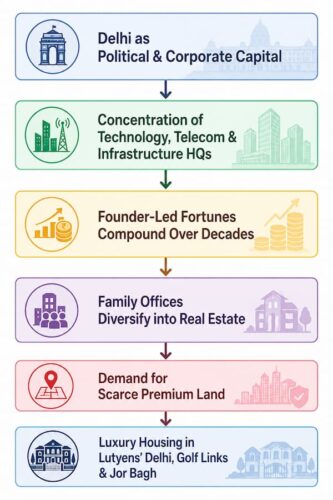
The concentration of wealth described throughout this guide has a direct, visible effect on Delhi’s premium residential market, one that can be traced through the same kind of chain that produced Nadar’s own fortune.
Delhi’s Wealth-to-Real-Estate Pipeline
The Land Scarcity Mismatch
Luxury bungalow demand in zones like Lutyens’ Delhi, Golf Links and Jor Bagh has grown steadily alongside the city’s billionaire and near-billionaire population, while the physical supply of large plots in those specific zones has stayed essentially fixed for decades. That mismatch between growing demand and static, planning-protected supply is the single biggest driver of premium land scarcity in Delhi.
It explains why prices in these pockets have historically outpaced broader city-wide residential trends, regardless of which individual families are buying in any given year.
Real Estate as an Asset Class
Business families increasingly treat this real estate as a distinct asset class rather than simply a place to live. Sunil Mittal, for example, holds a 50 percent stake in Brookfield India Real Estate Trust, acquired through a 2024 sale of a portfolio of commercial properties in Delhi, and separately still owns close to 3.85 million square feet of property through Bharti Realty.
That scale of holding functions as much as a family investment vehicle as a personal residence. Family offices and promoter holding companies of the kind described earlier in this guide frequently allocate a portion of diversified wealth into premium and commercial Delhi real estate precisely because supply is so constrained, which in turn reinforces scarcity and supports valuations further, a self-reinforcing loop rather than a one-time effect.
High-End Redevelopment
Older bungalows in Golf Links, Jor Bagh and parts of South Delhi are increasingly rebuilt to modern specifications on the same restricted footprint rather than subdivided, since zoning often restricts subdivision. A full teardown-rebuild is usually the only way to add contemporary amenities without losing the plot’s original, prestige-carrying address.
For South Delhi buyers and renters exploring this belt, the practical takeaway is the same one this guide keeps returning to: scarcity, not any single individual’s presence, is what continues to make these neighborhoods some of the most sought-after residential pockets in the country.
Frequently Asked Questions
Who is the richest man in Delhi in 2026?
Shiv Nadar, founder of HCL Technologies, is generally cited as Delhi’s richest man in 2026. Forbes’ real-time tracker placed his net worth at roughly $25.7 billion in early July 2026, while its October 2025 India rich list put him at $33.2 billion.
Telecom entrepreneur Sunil Mittal, also based in Delhi, is close enough in wealth that some snapshots, including that same October 2025 Forbes list, place him marginally ahead. That is why the title is best understood as a close, shifting contest at the very top rather than a fixed, permanent rank.
What company made Shiv Nadar wealthy?
Nearly all of Shiv Nadar’s wealth comes from HCL Technologies, the IT services company he co-founded in 1976. What began as a business selling teledigital calculators grew into a global technology company reporting $14.7 billion in revenue for the year ended March 2026, with 227,000-plus employees across 60 countries.
Nadar and his family hold their stake mainly through promoter-holding companies rather than direct shares, which is the primary source of his net worth and the reason its value moves with HCL Technologies’ daily stock price.
How is Shiv Nadar’s net worth actually calculated?
His net worth is an estimate, not a fixed figure, based on the market value of his family’s promoter shareholding in HCL Technologies. Trackers like Forbes, Hurun and Bloomberg apply different valuation dates, exchange rates and rules for attributing shared family wealth to a single name, which is why their published figures rarely match exactly.
Stock price movement, dividend income, and the 2025 transfer of shares to his daughter all factor into why the number has shifted meaningfully over the past two years.
Who currently leads HCL Technologies?
Roshni Nadar Malhotra has served as Chairperson of HCL Technologies since August 2020, when she became the first woman to chair a listed Indian IT company. In March 2025, she became the company’s majority shareholder after her father transferred a large portion of his promoter holdings to her, a move widely reported as the final stage of the family’s succession plan.
Day-to-day operations are led by C Vijayakumar, who has served as Chief Executive Officer and Managing Director since 2021 and reports to Roshni Nadar Malhotra and the company’s board.
Is Shiv Nadar still involved in HCL?
Yes, though in an advisory rather than operational capacity. Nadar stepped down as CEO in 2007 and as Chairman in August 2020, completing a gradual, multi-year succession that was publicly telegraphed years in advance.
His current title is Chairman Emeritus and Strategic Advisor, a role that keeps him connected to major strategic decisions without day-to-day executive responsibility. He also remains a significant, though no longer majority, shareholder following the 2025 transfer of shares to his daughter.
Is Shiv Nadar a philanthropist?
Yes, and one of India’s most consistently ranked ones. Through the Shiv Nadar Foundation, established in 1994, he and his family donated ₹2,708 crore in FY25 alone, topping the EdelGive Hurun India Philanthropy List 2025 for the fourth time in five years, with lifetime giving through the foundation estimated by Forbes at more than $1.1 billion.
His giving is concentrated almost entirely in education, funding institutions including Shiv Nadar University, SSN College of Engineering, and the VidyaGyan schools for gifted rural students in Uttar Pradesh.
Where do Delhi’s richest people generally live?
Delhi’s wealthiest households, across industries and not tied to any one individual, tend to cluster in a handful of low-density, large-plot neighborhoods rather than luxury towers: the government-planned Lutyens’ Delhi zone, Golf Links, Jor Bagh, the diplomatic enclave of Chanakyapuri, and Shanti Niketan.
These areas share large individual plots and limited supply, a legacy of Delhi’s colonial and early post-independence town planning, which is a large part of why they remain so exclusive today.
Why do billionaire rankings change so often?
Because they are built almost entirely on publicly traded share prices, which move every trading day, along with exchange rates and, periodically, internal family share transfers like the one that reshaped how Nadar’s wealth is now tracked. The full mechanics, including a combined timeline of net worth and succession events, are covered in the “How Is Shiv Nadar’s Net Worth Actually Calculated?” section above.
Final Thoughts
Wealth rankings will keep moving, sometimes by billions of dollars in a single quarter, but the structural decisions behind Shiv Nadar’s fortune move far more slowly, and they matter more. Retaining founder ownership instead of diluting it, entering a fifty-year growth industry near its very start, and executing a succession deliberately rather than reactively explain durable wealth better than any single day’s net worth figure ever could.
Understanding why a fortune was created is more useful than memorizing what it is worth this afternoon.
The same principle extends directly to the neighborhoods this wealth clusters around. Lutyens’ Delhi, Golf Links, Jor Bagh, Chanakyapuri and Shanti Niketan remain valuable not because of who currently lives there, but because the scarcity of land in each has been effectively locked in for decades, in much the same way Nadar’s ownership stake was locked in through five decades of retained control.
Billionaire rankings change daily. The mechanics that actually create lasting value, whether in a company or in a city’s most exclusive addresses, change far more slowly, and that is the more durable story here.
Sources consulted include Forbes’ real-time billionaires tracker and its “India’s 100 Richest 2025” list, the Hurun Global Rich List 2026, the EdelGive Hurun India Philanthropy List 2025, HCLTech’s official FY26 investor disclosures, and Bloomberg’s Billionaires Index. Net worth figures are estimates current as of the dates cited and will have moved by the time of publication; they should be refreshed before this piece goes live.
Written by the South Delhi Rentwala Editorial Team, which connects Delhi’s wealth map to the real neighbourhoods renters and buyers can actually explore. Learn more about us.
Published Feb 1, 2026 · Last Updated July 9, 2026 · 8 min read