
The Garden of Five Senses is a 20-acre public garden in Said-ul-Ajaib, just off Mehrauli-Badarpur Road and south of Saket. It is run by the Delhi Tourism and Transportation Development Corporation (DTTDC), it opens every day, and the nearest Metro station is Saket on the Yellow Line, a little under a kilometre away.
This guide covers what you actually need before you leave home: current timings, the current entry fee, the exact address, how to complete the last mile from Saket Metro station, what the garden contains, when to go, and how long to keep aside.
One thing to flag straight away, because it is the single most common error in published guides on this destination. Delhi Tourism’s own page for the garden lists the adult ticket at Rs 50, not the Rs 30 or Rs 35 that most travel sites still print. Recent visitor reports match Rs 50. The entry fee section below explains the discrepancy and how to plan for it.
Garden of Five Senses at a Glance
| Information | Details |
|---|---|
| Address | Westend Marg, Said-ul-Ajaib, Saket, New Delhi 110030 (off Mehrauli-Badarpur Road, south of Saket) |
| Managed by | Delhi Tourism and Transportation Development Corporation (DTTDC) |
| Timings | Open daily. 9:00 AM to 7:00 PM is the published summer schedule; 9:00 AM to 6:00 PM is widely published for October to March |
| Weekly closure | None. Delhi Tourism lists the garden as open daily |
| Entry fee | Rs 50 adult, Rs 20 child, Rs 20 senior citizen (Delhi Tourism published rate). Camera charge Rs 100 plus GST |
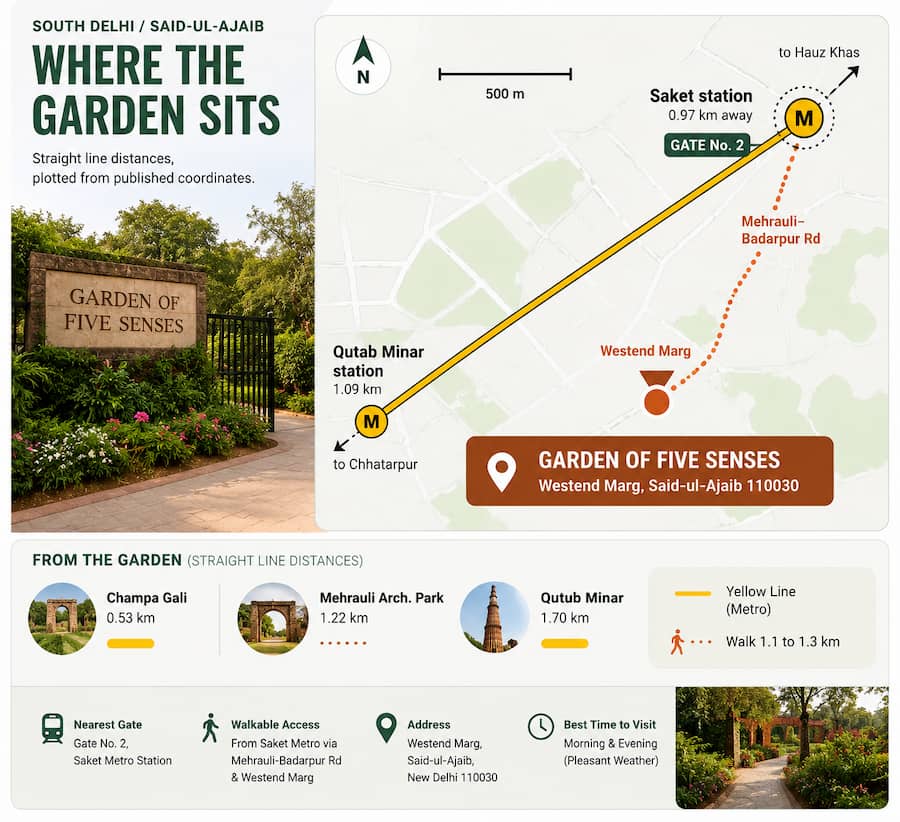
| Nearest Metro | Saket, Yellow Line. About 0.97 km in a straight line, roughly 1.1 to 1.3 km on foot |
| Area | 20 acres (DTTDC’s own architecture note gives 20.5 acres) |
| Opened | February 2003 |
| Best time to visit | Mid-October to mid-March, arriving either soon after 9:00 AM or after 4:00 PM |
| Time to keep aside | 90 minutes for a normal walk-through; 2 to 3 hours if you are photographing or sitting |
| Caption: The core visit details for the Garden of Five Senses, with each figure traced to its source in the sections below. | |
History and Design
The garden was built by DTTDC to answer a specific gap: Delhi had monuments and it had municipal parks, but it had very little public space designed for people to simply spend an afternoon in. The site chosen was a rocky patch of Said-ul-Ajaib village near the Mehrauli heritage belt, close to Qila Rai Pithora, the first city of Delhi. Construction took about three years at a reported cost of around Rs 10 crore, and the garden opened to the public in February 2003.
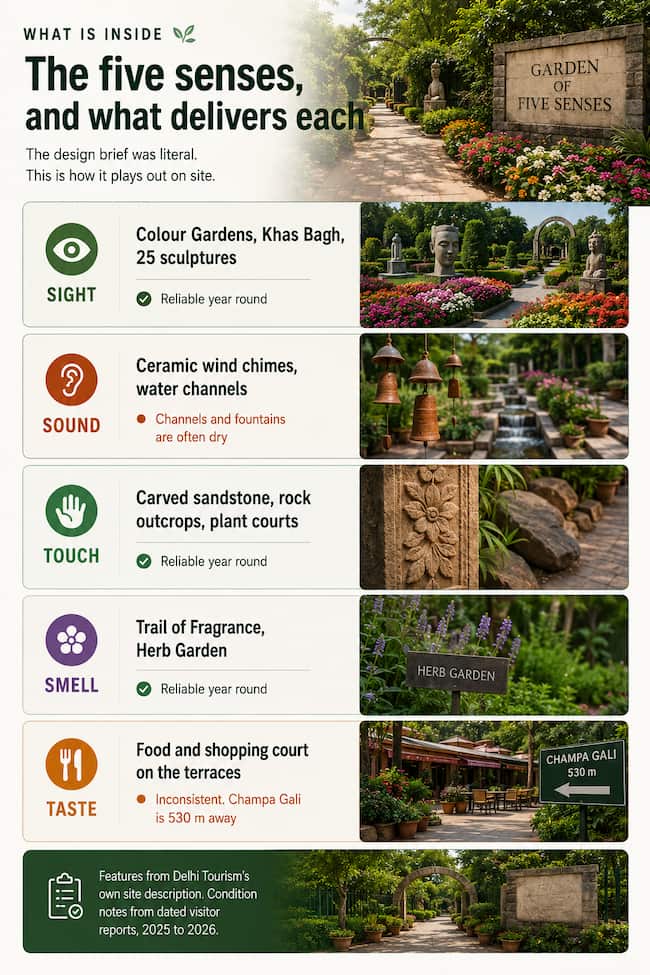
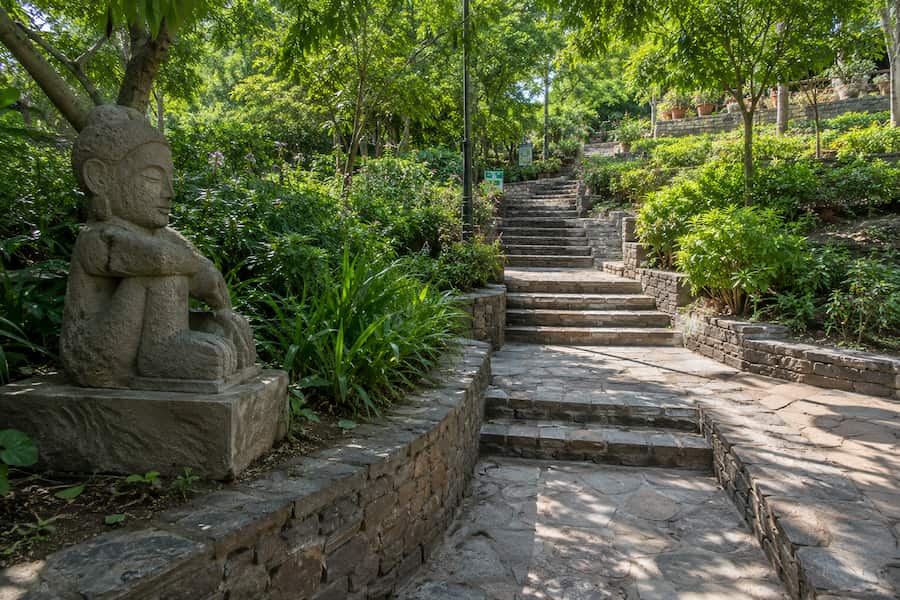
The design is by Delhi architect Pradeep Sachdeva. The brief he worked to was literal: build a landscape that engages sight, sound, touch, smell and taste rather than one that is only looked at. That intention explains most of what a visitor encounters. Colour and flowering shrubs handle sight. Ceramic wind chimes and water channels handle sound. Carved stone and textured plant surfaces are meant to be touched. A fragrance trail and a herb garden handle smell. The food and shopping court was built in to handle taste.
The site’s natural rock outcrops were kept rather than levelled, which is why the garden climbs and drops instead of running flat. Existing vegetation, including local kikar and thorny ber, was left standing in large stretches, with roughly two hundred plant varieties introduced around it. Boundary walls and the dome-shaped office block use stone that echoes the Qila Rai Pithora fortifications visible on the approach road.
The garden also functions as a public art site. DTTDC counts around 25 sculptures and murals across the grounds, which it describes as one of the larger collections of public art in the country. The stainless-steel birds on slate-clad pillars at the entrance, the stone elephants in their water bath, and the pinwheel-inspired steel sculpture on the northern ridge are the pieces most visitors remember.
What Is Inside the Garden
The layout is not a loop with a fixed route. A spiral walkway climbs from the entrance plaza, and the garden opens out from there in several directions. These are the parts worth knowing about before you go.
- Khas Bagh: a formal Mughal-style garden with water channels running its length, fragrant shrubs along the paths, and a central axis of fountains
- Neel Bagh: a water lily pool ringed by pergolas carrying climbing plants
- Colour Gardens: compositions of flowering shrubs and ground cover, the section that changes most between seasons
- Courts of Specimen Plants: bamboo, cacti and succulents, and a herb garden of medicinal species
- Trail of Fragrance: a scented walk leading up to the rocky ridge on the northern side of the site
- Amphitheatre: an open-air stage set into the natural slope with sandstone block seating, used for cultural programmes
- Solar energy park and open exhibition area used for art displays and workshops
- Food and shopping court, set away from the centre of the garden on terraced seating
Two honest caveats belong here, because they change what you should expect.
First, the water features are not reliably running. Visitors through 2025 and 2026 have repeatedly reported the central fountains, the water channels in Khas Bagh and the lily pools sitting dry or poorly maintained. If the water is the reason you are going, treat it as a bonus rather than a certainty.
Second, the food situation inside has thinned out. DTTDC licensed a large set of food and craft outlets here from 2005, and older accounts describe a busy court with full restaurants and bars. Current reports are inconsistent: some visitors find snack stalls and a canteen, others describe the sit-down restaurants as gone. Do not plan a meal around the garden’s internal outlets. If you want a proper sit-down option, Champa Gali, the cafe lane in Said-ul-Ajaib, is about 530 metres from the garden and works well as an after-visit stop.
There is also a practical point about the terrain. The garden runs across genuine gradients, with inclines, steps and uneven stone paths. Wear shoes you can walk in. Visitors using wheelchairs or pushing prams can manage parts of the site but not all of it comfortably.
In January 2026, DTTDC began a horticulture and landscaping programme at the garden estimated at Rs 48.75 lakh, covering large-scale seasonal planting (ranunculus, primula, dahlia, salvia, aster, pansy, petunia, dianthus and marigold), soil preparation, pruning and replacement of dead plants. This is worth knowing because it means the flowering displays in the 2026 to 2027 season should be better stocked than the thin coverage several 2025 visitors complained about.
Garden of Five Senses Timings
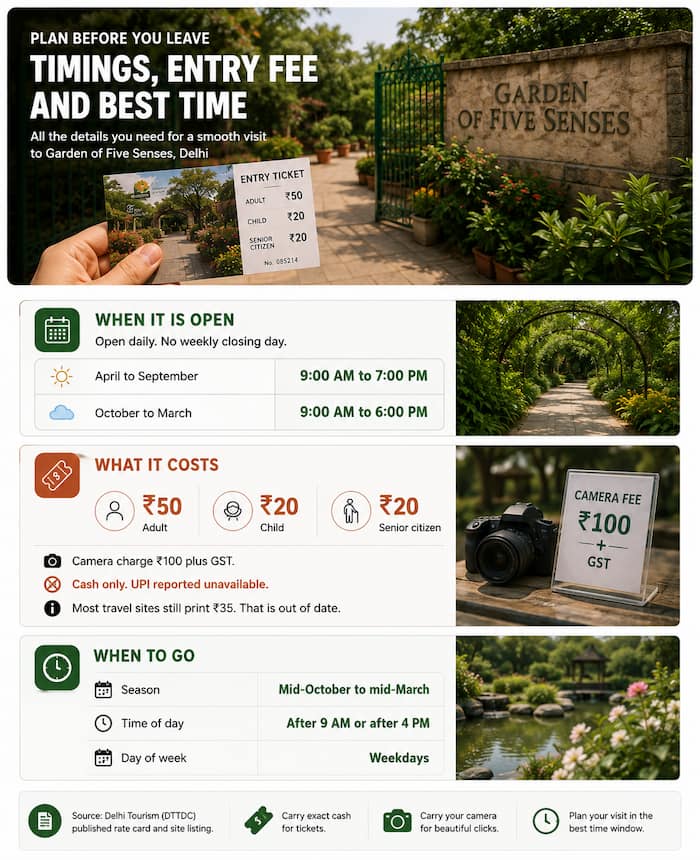
The garden is open daily, with no weekly closing day. Delhi Tourism’s own listing for the site states simply that it is open daily, and no published DTTDC notice mentions a Monday or any other weekly closure. Guides that show a Monday closure for this garden are wrong.
On the hours themselves, the sources genuinely disagree, so here is the position rather than a single confident number.
| Source | Timings Shown | How To Read It |
|---|---|---|
| Delhi Tourism (DTTDC) site page | “Open: Daily”, no hours listed | Confirms daily opening; does not settle the closing time |
| Google listing for the garden | 9:00 AM to 7:00 PM, all seven days | Currently displayed year-round; Google does not carry seasonal variants |
| Long-standing published schedule | 9:00 AM to 7:00 PM April to September; 9:00 AM to 6:00 PM October to March | The seasonal pattern the garden has historically followed |
| Caption: What each source says about Garden of Five Senses timings, and what each one is actually good evidence for. | ||
The safe way to plan around this: treat 6:00 PM as the effective closing time between October and March, and 7:00 PM between April and September. Aim to be inside at least an hour before that. Delhi gardens routinely stop selling tickets and start clearing visitors before the stated closing time, and the light goes early in winter regardless of when the gates shut.
During the annual Garden Tourism Festival in February, the garden runs on separate event hours and separate ticketing, so check the event listing rather than the regular timings for those three days.
Garden of Five Senses Entry Fee
Delhi Tourism’s published rate card for the garden is:
| Visitor Category | Ticket Price | What To Know |
|---|---|---|
| Adult | Rs 50 | Per person, charged at the gate |
| Child | Rs 20 | Concession has historically applied up to age 12 |
| Senior citizen | Rs 20 | Carry ID in case it is asked for |
| Camera charge | Rs 100 plus GST | Applies to camera equipment, not ordinary phone photos |
| Visitors with disabilities | Free entry is widely reported | Not stated on the current DTTDC rate card; confirm at the counter |
| Caption: Garden of Five Senses entry fee by visitor category, as published by Delhi Tourism. | ||
Why other pages show Rs 30 or Rs 35
Almost every travel page covering this garden still prints Rs 35 for adults and Rs 15 for children and seniors, and a few print the older Rs 30 and Rs 10. Both figures are out of date. Rs 30 and Rs 10 was the rate on Delhi Tourism’s own older festival page. Rs 35 and Rs 15 circulated for years after that. The current DTTDC page for the garden lists Rs 50, Rs 20 and Rs 20, and visitors reporting from the gate through 2025 and 2026 consistently describe paying Rs 50 per head.
Budget Rs 50 per adult. If the counter charges less, you are ahead.
Practical points at the counter
Tickets are sold at the entrance. There is no online booking for ordinary daily entry, so ignore pages that describe a Delhi Tourism booking flow for a normal visit; online ticketing appears only for specific events. Carry cash. Visitors have reported that UPI was not accepted at the ticket counter, which catches people out. There is a single main entrance, so there is no risk of queueing at the wrong gate.
Event days are priced separately. During the Garden Tourism Festival, entry has been charged at festival rates rather than the standard ticket.
How to Reach the Garden of Five Senses
The address to give a driver or type into a maps app is Garden of Five Senses, Westend Marg, Said-ul-Ajaib, Saket, New Delhi 110030. It sits just off Mehrauli-Badarpur Road, on the Mehrauli side of Saket, and is signposted from the main road.
Use the full name. “Saket” alone will take you to the Saket district centre and the malls, which are around 2.7 km away on the other side of the locality. “Said-ul-Ajaib” alone will drop you in the village lanes.
Getting to Saket from around the city
Every practical route converges on the same point, so the journey is easier to plan than it looks.
From central Delhi, take the Yellow Line south from Rajiv Chowk, New Delhi or Central Secretariat straight through to Saket with no change at all. From Gurugram, the same line runs north from Millennium City Centre through to Saket, again with no change. From east or north-east Delhi, change onto the Yellow Line at Kashmere Gate or interchange at Central Secretariat. From west Delhi, the Magenta Line to Hauz Khas and then two stops south on the Yellow Line is usually quickest.
From Indira Gandhi International Airport, either take the Airport Express to New Delhi and switch to the Yellow Line, or simply take a cab, since the road route through Vasant Kunj and Mehrauli avoids the city centre. From Hazrat Nizamuddin railway station, a cab is the sensible choice; it is the closest of Delhi’s major railway terminals to the garden.
By bus
The garden is served by the Saidulajab and Saket Metro Station stops on Mehrauli-Badarpur Road, about the same distance from the entrance as the Metro station itself. Several DTC and cluster services run this corridor, including routes in the 427, 463 and 522 families. Route numbers on this stretch change from time to time, so confirm on a live transit app on the day rather than relying on a published list. Once you are off the bus, the last mile is identical to the walk from the Metro.
Which option to pick
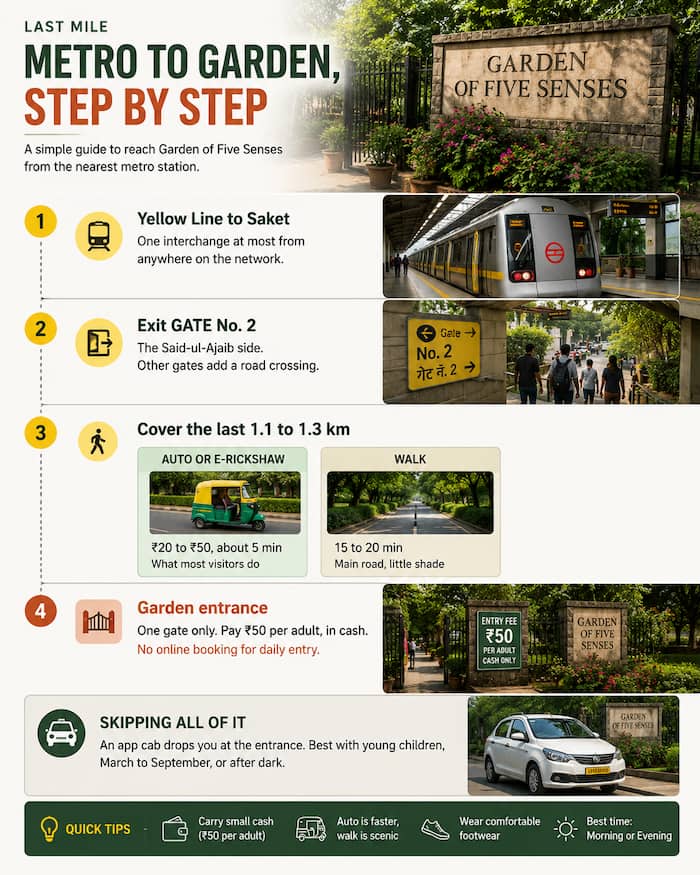
Take the Metro and then an auto if you are travelling alone or as a couple and want the cheapest reliable trip. Take an app cab if you have young children, if it is between March and September, or if you are leaving after dark. Drive only if you are carrying picnic things or travelling as a group of four or more, and avoid weekend afternoons on Mehrauli-Badarpur Road. Walk from Saket only between November and February; the distance is short but the route is a traffic-heavy main road, not a pleasant approach.
| Option | Best For | Typical Cost | Practical Consideration |
|---|---|---|---|
| Metro to Saket, then walk | Anyone on the Yellow Line in cool weather | Metro fare only | Roughly 15 to 20 minutes on foot along a busy main road |
| Metro to Saket, then auto or e-rickshaw | Most visitors, most of the year | Around Rs 20 to Rs 50 | Autos and e-rickshaws wait outside the station; the ride is short |
| App cab door to door | Groups, families with young children, summer visits | Varies by origin and surge | Drops you at the entrance; no last-mile problem at all |
| Own car | Families and groups carrying things | Paid parking, reported around Rs 50 for four hours | Mehrauli-Badarpur Road is slow on weekends and holidays |
| DTC or cluster bus | Visitors already travelling this corridor | Bus fare only | Get down at Saidulajab, then the same last mile as from the Metro |
| Caption: Ways to reach the Garden of Five Senses compared on cost, suitability and the practical catch in each. | |||
The garden sits inside the Mehrauli and Saket belt, so most visitors are combining it with something else in the area. Qutub Minar is about 1.7 km away, Mehrauli Archaeological Park about 1.2 km, and the Saket malls about 2.7 km. If you are planning the wider trip, our guide to South Delhi’s shopping malls and the list of South Delhi localities cover that side of the outing.
Nearest Metro Station
The nearest Metro station is Saket, on the Yellow Line. In a straight line it is 0.97 km from the garden, and the walking route runs roughly 1.1 to 1.3 km depending on the exit you use and where you cross.
Take Gate No. 2 at Saket station. That is the exit oriented towards Said-ul-Ajaib, and the gate Delhi Tourism has used for its free festival shuttle. The wrong gate adds several minutes and a road crossing you do not need.
From Gate No. 2 the walk is simple: head south-west along Mehrauli-Badarpur Road, turn off at the Saidulajab junction onto Westend Marg, and continue to the entrance. It is a main-road walk with traffic alongside, which is why most visitors take an auto for the last stretch despite the short distance.
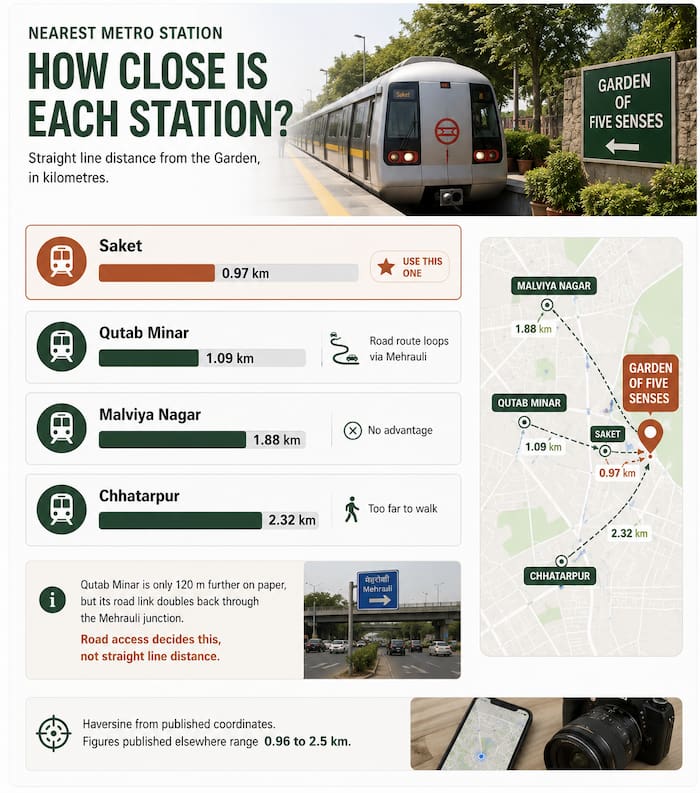
| Metro Station | Line | Straight Line Distance | Verdict |
|---|---|---|---|
| Saket | Yellow | 0.97 km | Use this one. Direct road link and plenty of last-mile transport |
| Qutab Minar | Yellow | 1.09 km | Nearly as close on paper, but the road route loops the long way round |
| Malviya Nagar | Yellow | 1.88 km | No advantage unless you are already stopping there |
| Chhatarpur | Yellow | 2.32 km | Too far to walk; only useful if you are coming from the Gurugram side |
| Caption: Metro stations near the Garden of Five Senses, measured as straight-line distance from the garden’s coordinates. | |||
The Qutab Minar comparison explains why published distances for this garden vary so wildly. On paper that station is only about 120 metres further than Saket, but it sits on the Anuvrat Marg side and its road connection doubles back through the Mehrauli junction. Straight-line distance is a poor guide here; road access decides it, and on road access Saket wins clearly.
All four stations are on the Yellow Line. Our Delhi Metro Yellow Line stations guide has the full station list, fares and interchange detail for planning the Metro leg itself.
How to Reach by Car, Taxi or Auto
By car
Approach on Mehrauli-Badarpur Road and turn off at the signed entry for the garden near Saidulajab. Paid parking is available at the garden, and visitor guides consistently report rates around Rs 50 for four hours for a four-wheeler and Rs 25 for a two-wheeler. Those figures are not published on any DTTDC schedule we could verify, so treat them as indicative rather than fixed.
The real constraint is not parking capacity but the road. Mehrauli-Badarpur Road is one of South Delhi’s busiest east-west corridors and backs up badly on weekends, public holidays and festival days. If you are driving on a Sunday, leave earlier than you think you need to.
By taxi or cab
App-based cabs serve this address reliably and will drop you at the entrance, which removes the last-mile question entirely. Set the destination as “The Garden of Five Senses” rather than typing an area name. This is the simplest option for families with small children, for anyone visiting in May or June, and for anyone leaving after dark.
By auto-rickshaw
An auto or e-rickshaw from Saket Metro station is the standard last-mile choice and the one most locals use. Expect roughly Rs 20 to Rs 50 depending on the vehicle and how you negotiate. E-rickshaws are usually the cheaper of the two. Drivers at Saket station know the garden well, so you should not need to explain the route.
Best Time to Visit the Garden of Five Senses
Season: mid-October to mid-March. This is not a generic winter recommendation. It matters for three specific reasons here.
The first is shade. Large parts of this garden are open rock and open lawn, and the walk involves climbing. Delhi’s April to June heat, regularly above 40 degrees, makes those stretches genuinely unpleasant, and the site does not offer much relief.
The second is the flowering cycle. The Colour Gardens and the seasonal beds are what change most between visits, and they peak from late winter into early spring. February and early March are the strongest weeks, which is also when Delhi Tourism holds its Garden Tourism Festival here. The Rs 48.75 lakh replanting programme started in January 2026 should make the coming winter season better stocked than recent ones.
The third is the monsoon. July to September leaves lawns waterlogged, stone paths slippery on the gradients, and flowering thin. The greenery is at its densest, but the walking is at its worst.
Time of day: soon after 9:00 AM, or after 4:00 PM. Early morning gives you the quietest garden and the best light on the sculptures. Late afternoon gives you softer light and cooler stone, and the hour before closing is when the garden looks its best. Avoid the middle of the day in any month from March onwards.
Day of week: weekdays if you can. This is one of South Delhi’s most popular spots for couples, and weekends, public holidays and Valentine’s week bring a substantially heavier crowd. Weekday mornings are close to empty.
How Much Time Do You Need at the Garden
| Type Of Visit | Time To Keep | What You Will Cover |
|---|---|---|
| Quick walk-through | 45 to 60 minutes | Entrance plaza, Khas Bagh, main sculpture stretch |
| Standard visit | 90 minutes | Most of the themed gardens, the ridge and the amphitheatre |
| Photography or a relaxed sit | 2 to 3 hours | The full site at an unhurried pace, with time to stop |
| With young children | 60 to 90 minutes | Level sections and the open lawns; the gradients tire children quickly |
| Caption: Realistic visit durations at the Garden of Five Senses by type of visit. | ||
If you are combining the garden with Qutub Minar or Mehrauli Archaeological Park in one outing, keep 90 minutes here and give the monuments the rest of the day. The garden works better as the calm half of a South Delhi morning than as a full-day destination on its own. Add 20 to 30 minutes at either end for the ticket queue on a weekend and the last-mile trip from Saket station.
Is the Garden of Five Senses Worth Visiting
It is worth the trip if you want an unhurried outdoor walk with something to look at, and you are comfortable with a site that is well conceived but unevenly maintained.
It suits couples, who make up a large share of visitors. It suits anyone interested in landscape design, public sculpture or plant collections, because there is genuine substance to look at rather than just lawn. It suits local residents wanting a change from a neighbourhood park. And it suits photographers, particularly in the late afternoon.
Adjust expectations in three situations. If you are expecting a monument, this is a garden built in 2003, not a heritage site; Qutub Minar is 1.7 km away and is the monument. If you are expecting an activity-driven family attraction, there are no rides or play structures of any scale, and the gradients make it hard work with a pram. And if you are expecting the water features and fountains that appear in most photographs of this place, be prepared for them to be dry.
Some families also find the density of couples uncomfortable, particularly in the more secluded corners on weekends. Weekday mornings are noticeably different in this respect.
Frequently Asked Questions
Where is the Garden of Five Senses located?
The Garden of Five Senses is at Westend Marg, Said-ul-Ajaib, Saket, New Delhi 110030, just off Mehrauli-Badarpur Road on the Mehrauli side of Saket in South Delhi. It sits close to the Mehrauli heritage belt, around 1.7 km from Qutub Minar and 1.2 km from Mehrauli Archaeological Park. When searching in a maps app or telling a driver, use the full name “Garden of Five Senses” rather than just “Saket”, which will take you to the district centre and malls instead.
What is the Garden of Five Senses entry fee?
Delhi Tourism’s published rate for the garden is Rs 50 for adults and Rs 20 each for children and senior citizens, with a camera charge of Rs 100 plus GST. Free entry for visitors with disabilities is widely reported but is not stated on the current rate card, so confirm at the counter. Most travel pages still show Rs 35 or Rs 30, which are outdated. Budget Rs 50 per adult and carry cash, since UPI has been reported as unavailable at the ticket window.
What are the Garden of Five Senses timings?
The garden opens daily at 9:00 AM with no weekly closing day. Closing time is where sources disagree: the long-published schedule is 7:00 PM from April to September and 6:00 PM from October to March, while the current Google listing shows 7:00 PM year-round. Delhi Tourism’s own page confirms daily opening without listing hours. Plan around a 6:00 PM close in winter and 7:00 PM in summer, and arrive at least an hour before that.
Which metro station is closest to the Garden of Five Senses?
Saket Metro station on the Yellow Line is closest, at about 0.97 km in a straight line. Use Gate No. 2, which faces the Said-ul-Ajaib side and the garden. Qutab Minar station is only marginally further in straight-line terms at 1.09 km, but its road connection loops back through the Mehrauli junction and makes the journey longer, so Saket remains the practical choice. Malviya Nagar and Chhatarpur are further and offer no advantage.
How far is the Garden of Five Senses from the nearest metro station?
The straight-line distance from Saket Metro station to the garden is 0.97 km, calculated from the two locations’ coordinates. The walking route is longer, roughly 1.1 to 1.3 km, because you follow Mehrauli-Badarpur Road and then turn onto Westend Marg. That works out to about 15 to 20 minutes on foot. Published figures for this stretch range from 0.96 km to 2.5 km, which is why it is worth stating the method rather than a single number.
How can I reach the Garden of Five Senses by Metro?
Take the Yellow Line to Saket station, which needs at most one interchange from anywhere on the Delhi Metro network. Exit at Gate No. 2. From there, either walk south-west along Mehrauli-Badarpur Road and turn onto Westend Marg, or take an auto or e-rickshaw from the stand outside the station for roughly Rs 20 to Rs 50. The auto is the sensible choice in summer or if you are carrying anything.
Is parking available at the Garden of Five Senses?
Yes, paid parking is available at the garden for cars and two-wheelers. Visitor guides consistently report about Rs 50 for four hours for a four-wheeler and Rs 25 for a two-wheeler, though these rates are not published on any official DTTDC schedule, so treat them as indicative. The bigger practical issue is traffic rather than space: Mehrauli-Badarpur Road congests heavily on weekends, public holidays and during February’s Garden Tourism Festival.
What is the best time to visit the Garden of Five Senses?
Mid-October to mid-March is the comfortable window, with February and early March strongest for flowering. Within the day, arrive soon after 9:00 AM or after 4:00 PM. Much of the garden is open rock and lawn with limited shade and real gradients, so the middle of the day is hard work from March onwards. Weekdays are considerably quieter than weekends. The monsoon leaves paths slippery and lawns waterlogged.
How long does it take to explore the Garden of Five Senses?
Keep 90 minutes for a standard visit covering the themed gardens, the rocky ridge and the amphitheatre. A quick walk-through of the entrance plaza, Khas Bagh and the main sculpture stretch takes 45 to 60 minutes. Photographers and anyone planning to sit for a while should keep 2 to 3 hours. With young children, 60 to 90 minutes is realistic, because the inclines and steps tire them faster than a flat park would.
Is the Garden of Five Senses suitable for families?
It works for families who want a walk and open space rather than an activity destination. There are no rides or significant play structures, and the gradients, steps and uneven stone paths make it hard going with a pram or for anyone with limited mobility. Some families also find the number of couples in the quieter corners uncomfortable, particularly at weekends. A weekday morning visit changes that experience noticeably.
Is the Garden of Five Senses good for couples?
It is one of the most popular spots in South Delhi for couples, largely because of its secluded seating, winding paths and quiet corners. Expect a lot of company on weekends, public holidays and around Valentine’s Day. Security staff are present but thinly spread. If you want the setting without the crowd, a weekday morning or the hour after 4:00 PM on a weekday gives you most of the garden to yourself.
Is the Garden of Five Senses worth visiting?
Yes, if you want an unhurried outdoor walk with landscape design and public art to look at, and you accept that maintenance is uneven. There are around 25 sculptures and murals, several distinct themed gardens and genuine design intent behind the layout. Set expectations on two points: the fountains, water channels and lily pools are frequently dry, and it is a 2003 garden, not a heritage monument. At Rs 50, it is still good value for 90 minutes.
Final Visit Summary
The Garden of Five Senses is at Westend Marg, Said-ul-Ajaib, Saket 110030, off Mehrauli-Badarpur Road. It opens daily at 9:00 AM, closing at 7:00 PM in summer and, on the long-published schedule, 6:00 PM from October to March. There is no weekly closing day.
Budget Rs 50 per adult and Rs 20 per child or senior citizen, in cash, and add Rs 100 plus GST if you are bringing a camera. Ignore the Rs 30 and Rs 35 figures still circulating online.
The easiest way to get there is the Yellow Line to Saket station, exit Gate No. 2, then a short auto or e-rickshaw ride, or a 15 to 20 minute walk if the weather is cool. App cabs drop you at the entrance and remove the last mile entirely.
Go between mid-October and mid-March, early morning or after 4:00 PM, ideally on a weekday. Keep 90 minutes. Expect landscaped gardens, roughly 25 sculptures, a Mughal-style formal garden, a rocky ridge walk and an amphitheatre, and do not count on the water features running. Wear shoes you can climb steps in, and plan to eat at Champa Gali, 530 metres away, rather than inside.