
Last verified: August 2026
Vasant Kunj gets recommended a lot, usually for the same three reasons: it is close to the airport, it has some of South Delhi’s biggest malls, and the DDA flats are more spacious than what you find in older colonies. All three are true. What gets left out is that Vasant Kunj still has no metro station of its own, that “close to the airport” and “close to a train that reaches the airport” are different things, and that the locality is really five sectors with noticeably different character, price and convenience. This guide covers what actually changes a renting or buying decision, not a repeat of the marketing lines.
Quick answer
Vasant Kunj is a large, DDA-developed residential locality in South West Delhi, at the western edge of what is commonly called South Delhi. It sits about 6 km from IGI Airport by the shortest route, has no operating metro station as of August 2026 (the nearest is Vasant Vihar on the Magenta Line, reached by auto), and carries a single PIN code, 110070, across all its sectors. Monthly rent runs roughly ₹30,000 to ₹60,000 for a standard flat, and resale flats average approximately ₹22,000 to ₹24,000 per square foot. It works well for people who drive or use cabs, want more space than a typical builder-floor colony, and value proximity to the airport, Gurugram and two large mall clusters. It works less well for anyone who wants to walk to a metro station today.
Vasant Kunj at a Glance
| Factor | Vasant Kunj in 2026 |
|---|---|
| Location | Western edge of South Delhi, adjoining Mahipalpur, Rangpuri and Vasant Vihar, close to IGI Airport and NH-48 toward Gurugram |
| District / administrative context | Falls under South West Delhi district for revenue and civic administration, PIN 110070, while functioning day to day as part of the South Delhi residential and retail belt |
| Area character | Planned residential, five sectors (A to E), mostly DDA flats and builder floors, with pockets of farmhouses and corporate offices |
| Best known for | Airport proximity, its two large mall clusters, and being one of South Delhi’s most spacious DDA-planned localities |
| Housing | DDA flats, private builder floors, mid-rise apartment societies, and farmhouses at the fringes |
| Metro access | No station inside Vasant Kunj yet. Nearest is Vasant Vihar (Magenta Line), reached by a short auto or e-rickshaw ride. A dedicated Vasant Kunj station is under construction on the Golden Line |
| Airport access | Roughly 6 km to the nearest terminal approach, among the shortest of any South Delhi locality, though actual drive time depends on the sector and the specific terminal |
| Gurugram access | Direct via NH-48, with the Shiv Murti and Mahipalpur stretch as the main bottleneck during peak hours |
| Shopping | Ambience Mall, DLF Promenade and DLF Emporio form one of Delhi’s largest retail clusters |
| Schools | Vasant Valley School, Delhi Public School Vasant Kunj and G.D. Goenka Public School are all inside the locality |
| Healthcare | Fortis Flt. Lt. Rajan Dhall Hospital for general and emergency care, and the Indian Spinal Injuries Centre for specialised spine and orthopaedic treatment |
| Best suited for | Families and professionals who drive or use cabs regularly, frequent flyers, and anyone prioritising space over a metro-adjacent address |
| Main drawbacks | No metro station yet, real dependence on private transport for daily errands, and a rental budget above most of South Delhi’s mid-range localities |
| Caption: A summary of Vasant Kunj’s location, housing, connectivity and cost profile as of 2026. | |
Where is Vasant Kunj?
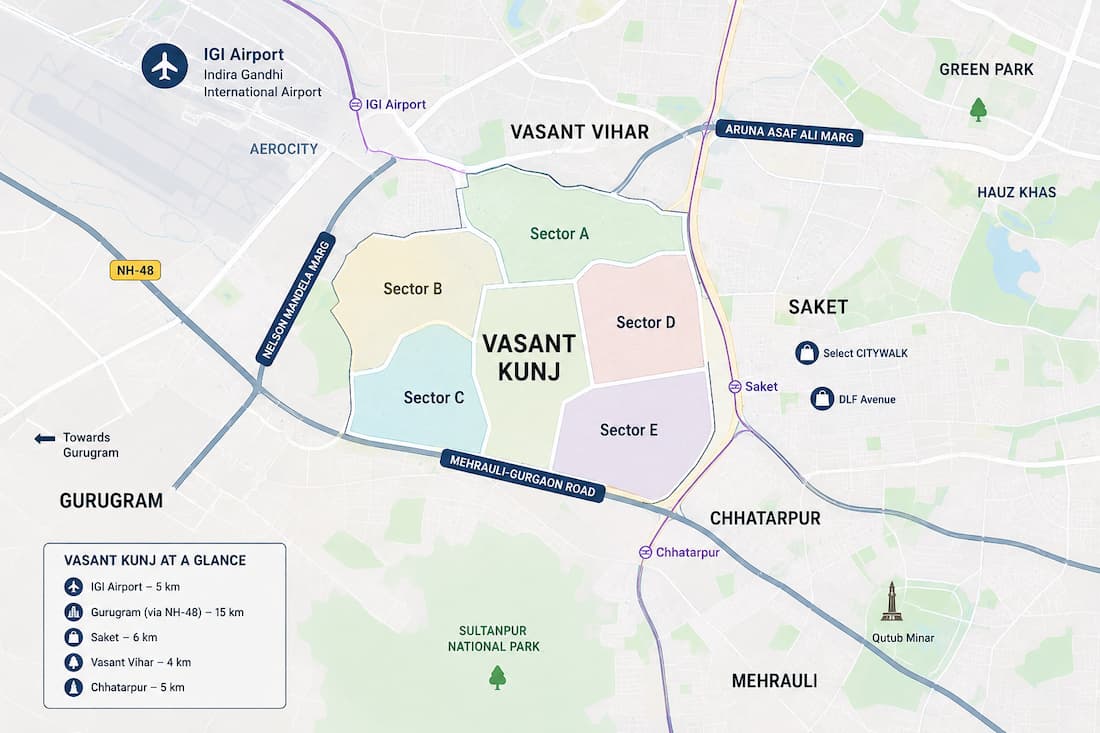
Vasant Kunj sits in the south-western part of Delhi, past Vasant Vihar and before the airport belt of Mahipalpur and Rangpuri. It was developed by the Delhi Development Authority from land acquired in and around Kishangarh village, with the main construction phase through the 1980s, when the DDA planned the township for a population of roughly 100,000. That history explains a lot about how the area looks today: wide internal roads, generous setbacks between buildings, and a layout organised into large numbered sectors rather than the tighter colony grids you see in older South Delhi neighbourhoods.
The locality’s direct neighbours are Vasant Vihar to the north-east, Mahipalpur and Rangpuri to the west toward the airport, Kishangarh and Masoodpur along its southern edge, and Chhatarpur and Mehrauli further south. Saket and Malviya Nagar sit to the south-east, reachable along Mehrauli-Badarpur Road rather than through Vasant Kunj directly. Munirka and R.K. Puram are to the north, across Nelson Mandela Marg.
Two roads carry most of the traffic in and out: Nelson Mandela Marg, which runs along Vasant Kunj’s northern edge and connects to NH-48 toward the airport and Gurugram, and Mehrauli-Gurgaon Road further south, which is the more direct but more congested route into Haryana. Aruna Asaf Ali Marg cuts through the middle of the locality and is where you will find the Fortis hospital and several of the larger societies. Vasant Kunj Marg links Sector C to Vasant Vihar and is the road most residents use to reach the metro.
The administrative picture is genuinely more complicated than most articles let on, and it is worth getting right rather than glossing over. For day-to-day life, shopping, schooling and property comparisons, Vasant Kunj functions as part of South Delhi and is marketed, searched for and compared that way, including by residents themselves. For revenue and civic administration, however, the locality falls within South West Delhi district, the same district that contains Dwarka, R.K. Puram and Vasant Vihar’s surrounding villages. This is not a contradiction. South Delhi as most people use the term is a lifestyle and real-estate belt, not a single revenue district, and several genuinely “South Delhi” addresses, Vasant Kunj among them, sit administratively inside South West Delhi. If a government form or a property document asks for your district, South West Delhi is the correct answer for a Vasant Kunj address, even though every rental portal, mall directory and school website will describe the same address as South Delhi.
What is Vasant Kunj like as a locality?
Vasant Kunj is organised into five sectors, A through E, each broken down further into pockets and then into lettered blocks within each pocket. A DDA flat address in Vasant Kunj typically reads something like Pocket 10, Sector B, or C2, Sector C, and knowing the sector matters more here than in most South Delhi localities, because the sectors genuinely differ from each other.
Sector C is the most institutional of the five. It holds Vasant Valley School, the Indian Spinal Injuries Centre, and several embassies and diplomatic residences, giving it a quieter, more formal character than the sectors built primarily as housing. Sector B is a dense residential stretch close to the Kishangarh side, with a mix of DDA flats and private apartment towers, and is generally the sector with the highest per-square-foot resale prices, reflecting both its build quality and its proximity to Nelson Mandela Marg. Sector A has some of the locality’s older DDA stock along with two of Vasant Kunj’s natural water bodies. Sector D sits closest to the metro depot land earmarked for the Golden Line and has a more mixed residential-commercial feel. Sector E is the newest and smallest, added later than the other four, with a narrower range of configurations available.
Beyond the numbered sectors, Vasant Kunj also has a farmhouse belt at its southern and western fringes, bordering the larger Chhatarpur farmhouse cluster, and a corporate presence that is unusual for a primarily residential locality. Bharti Enterprises, the parent company of Airtel, has its headquarters at Bharti Crescent on Nelson Mandela Marg, and the publisher Bloomsbury India runs its head office from the DDA complex in Sector B. This is not a business district in the way Gurugram or Aerocity are, but it does mean Vasant Kunj has daytime footfall and commercial activity that pure residential colonies lack.
The locality also has more green cover than its reputation as a shopping and airport hub suggests. Sanjay Van, part of the South-Central Ridge forest, borders Vasant Kunj and is genuinely used by residents for walking and running, not just as a scenic backdrop. The area is not uniformly quiet, though. Nelson Mandela Marg and the roads around the mall cluster carry heavy traffic through most of the day, and the contrast between a busy commercial pocket and a residential sector two streets away is sharper here than in more evenly built-up colonies.
Connectivity and transportation
Connectivity is the factor that decides more Vasant Kunj rent and purchase decisions than any other, and it is also the one where the locality’s reputation runs ahead of its current reality. The honest summary: Vasant Kunj is close to the airport and reasonably well placed for Gurugram, but its metro access still depends on a short private-transport hop rather than a direct walk, and that will not change until the Golden Line opens.
Metro
Vasant Kunj does not have an operating metro station within its sectors as of August 2026. The most-used current option is Vasant Vihar station on the Magenta Line, reached from most of Vasant Kunj by a five to ten minute auto or e-rickshaw ride along Vasant Kunj Marg, since it is not a comfortable walking distance for most residents. Chhatarpur station on the Yellow Line is a workable alternative for the southern pockets of the locality, and Delhi Aerocity on the Airport Express Line is useful specifically if you are already headed toward the airport. None of these sit inside Vasant Kunj itself, which is the detail most casual write-ups skip past.
That is set to change. A dedicated Vasant Kunj station is under construction on the Delhi Metro’s Golden Line, and it is covered in full in the section below, since it is significant enough to warrant its own explanation rather than a single line here.
Road connectivity
Vasant Kunj’s internal roads are wider than in most older South Delhi colonies, a direct result of its DDA master-planning, which makes it comparatively easy to drive within the locality. Getting out is straightforward too: Nelson Mandela Marg connects north-east to Vasant Vihar and Munirka and feeds into NH-48 toward the airport and Gurugram, while Mehrauli-Gurgaon Road runs south-west from the Chhatarpur side toward Haryana. Aruna Asaf Ali Marg and Vasant Kunj Marg handle most of the internal and cross-locality movement, including the routes to Vasant Valley School, the Fortis hospital and the mall cluster.
The one recurring complaint from residents concerns the stretch where NH-48 meets the Dwarka Expressway near Shiv Murti and Mahipalpur, just outside Vasant Kunj’s western edge. This merge point is a genuine bottleneck during peak hours and affects anyone heading toward the airport or Gurugram from Vasant Kunj, regardless of which sector they live in.
Airport
Vasant Kunj is the closest South Delhi residential locality to Indira Gandhi International Airport, at roughly 6 km by the shortest route, closer even than Connaught Place. That headline figure needs one honest caveat: 6 km is the straight-line or nearest-approach distance, and the actual driving distance to a specific terminal, particularly Terminal 1, can run closer to 10 to 15 km depending on which sector you start from and which road you take. Off-peak, a cab from Vasant Kunj to the airport typically takes 20 to 35 minutes. During rush hour, and especially with the Shiv Murti merge factored in, budget closer to 45 minutes. The Airport Express Line’s nearest useful stop, Aerocity, is itself a short cab ride from Vasant Kunj rather than a walk, so residents flying out generally drive or cab directly to the terminal rather than routing through the metro. For terminal-by-terminal detail, DigiYatra setup and what changes at each of IGI’s three terminals, our complete breakdown of IGI Airport’s terminals and transfers covers the full picture.
Gurugram
Vasant Kunj residents commuting to Gurugram have two realistic routes. NH-48 through Nelson Mandela Marg is the more direct highway option and is often the faster choice during peak hours, since it is built for volume even though it can add distance compared to smaller roads. Mehrauli-Gurgaon Road, reached via Chhatarpur, is shorter on the map for destinations in central Gurugram but runs through more local traffic and junctions. Both routes converge on the same Shiv Murti and Mahipalpur bottleneck mentioned above, so neither fully avoids it. Commuters heading specifically to Cyber City, Udyog Vihar or the NH-48 side of Gurugram generally find Vasant Kunj’s position an advantage over more central South Delhi addresses, since the highway approach is already close by. A more detailed breakdown of route choice and timing, built for the equivalent commute from Saket, is available in our analysis of the fastest routes into Gurugram from South Delhi, and the same NH-48 versus Mehrauli-Gurgaon Road logic applies directly to Vasant Kunj.
South Delhi and Central Delhi
Reaching the rest of South Delhi from Vasant Kunj means going through either Chhatarpur and Mehrauli-Badarpur Road toward Saket and Malviya Nagar, or through Munirka and R.K. Puram toward Hauz Khas and central South Delhi. Neither is a short hop. Central Delhi, meaning Connaught Place and the government district, is a genuine outer-edge commute from Vasant Kunj, typically 45 minutes or more by road depending on traffic, and this is one of the clearest trade-offs of choosing the locality: proximity to the airport and Gurugram comes at the cost of distance from the city centre. For a wider view of how the different metro corridors serve South Delhi as a whole, our overview of the metro lines serving South Delhi lays out which line suits which part of the district.
Buses
Buses are a genuinely useful, and often overlooked, option for anyone in Vasant Kunj who does not want to drive and finds the metro’s last-mile hop inconvenient. DTC routes connect the locality’s main roads to Mehrauli Terminal, the Vasant Vihar bus depot, and onward toward Saket and central Delhi, with reasonable frequency on the busier corridors like Nelson Mandela Marg and Mehrauli-Gurgaon Road. It is not a substitute for the metro on speed, but for short, budget-conscious hops within South Delhi, particularly for residents who are not driving and want to avoid auto fares for every trip, buses cover more of Vasant Kunj’s day-to-day travel than most people assume.
Vasant Kunj metro connectivity: what residents should know
The single most important thing to understand about Vasant Kunj and the metro is that the nearest station and the most useful station are not the same thing, and neither is inside the locality yet.
| Metro Station | Line | Relevance to Vasant Kunj | Typical Last-Mile | Best For |
|---|---|---|---|---|
| Vasant Vihar | Magenta Line | Most commonly used station today for most of Vasant Kunj | Auto or e-rickshaw, roughly 5 to 10 minutes, not a walking distance | Sectors B, C and D, and connections toward Hauz Khas and Botanical Garden |
| Chhatarpur | Yellow Line | Useful alternative for the southern edge of Vasant Kunj | Auto or cab, generally longer than the Vasant Vihar trip for most sectors | Residents near the Sector D and farmhouse-belt side, and journeys toward Saket and Gurugram via the Yellow Line |
| Delhi Aerocity | Airport Express (Orange Line) | Relevant mainly for airport trips, not for daily city commuting | Short cab ride, not designed for casual walk-in use | Residents flying frequently who want a fast, dedicated link to New Delhi Railway Station |
| Vasant Kunj (under construction) | Golden Line (Line 10) | Will be the locality’s first station once operational, tunnelling substantially complete as of 2026 | Not yet applicable, station under construction | Future direct link to the airport, Chhatarpur and Tughlakabad once the line opens |
| Caption: Current and upcoming metro stations relevant to Vasant Kunj, with realistic last-mile expectations for each. | ||||
The Golden Line, explained properly
The Golden Line is the reason most current Vasant Kunj metro coverage online is already out of date within months, so it is worth walking through the actual construction status rather than repeating a completion date that may have already slipped.
The line, officially Line 10 of the Delhi Metro’s Phase 4 expansion, runs from Aerocity to Tughlakabad and includes a dedicated Vasant Kunj station among fifteen stations on its main stretch, alongside Mahipalpur, Kishangarh, Chhatarpur, Chhattarpur Mandir, IGNOU, Neb Sarai, Saket G-Block, Ambedkar Nagar, Khanpur, Sangam Vihar-Tigri, and stations toward Tughlakabad. Once open, it will interchange with the Airport Express Line and the under-construction Namo Bharat corridor at Aerocity, with the Yellow Line at Chhatarpur, and eventually with the Violet Line at Tughlakabad.
Construction has moved forward visibly. The tunnel boring breakthrough at Vasant Kunj station was completed in March 2025, and by mid-2026 the Delhi Metro Rail Corporation’s own spokesperson had confirmed roughly 71 percent overall progress and 78 percent civil construction complete, with multiple tunnel boring machines still active on the Aerocity to Vasant Kunj stretch specifically. DMRC’s public statements through 2026 have pointed toward some sections opening before the end of the year, while independent infrastructure trackers, who have watched this project slip from an original 2024-25 target before, are more cautious and place a realistic opening closer to mid-2027. Treat both as honest estimates rather than a confirmed date, and treat “opening by late 2026” as a possibility rather than a plan you should base a lease or purchase decision on.
What this means practically: if you are renting for a year or two, do not choose or reject Vasant Kunj based on an assumption that the metro will be open by the time your lease is up, since that is genuinely uncertain. If you are buying with a five-year-plus horizon, the Golden Line is a reasonable factor to weigh in, since even a 2027 opening still falls well within that window, and the corridor’s construction has visibly progressed rather than stalled.
Housing and property market
Vasant Kunj’s housing stock is more varied than a typical DDA colony, spanning original DDA-allotted flats from the 1980s and 1990s, private builder floors built on subdivided plots, mid-rise apartment societies constructed more recently, and a farmhouse belt along the southern and western edges where plot sizes and prices operate on an entirely different scale from the sectors. DDA has also periodically added to the stock well after the original development, including a 2019 scheme that offered flats in Vasant Kunj alongside Narela, so not all DDA inventory here is decades old.
Builder floors, typically three or four independent units stacked within a single building on a subdivided plot, are common in Sectors B and C and tend to offer more layout flexibility than the original DDA flats, at a price premium. The DDA flats themselves vary widely in condition depending on whether the individual owner has renovated, since DDA’s own upkeep of common areas in older blocks is inconsistent, a point worth checking in person rather than assuming from a listing photo.
Current rent in Vasant Kunj
| Property Type | Typical Current Rent Range | Factors Affecting Rent |
|---|---|---|
| 1 BHK / studio | ₹16,000 to ₹35,000 per month | Sector, building age, furnishing level, and whether it is a standalone DDA flat or part of a maintained society |
| 2 BHK | ₹35,000 to ₹55,000 per month | Floor, built-up area (typically 850 to 1,100 sq ft in this configuration here), furnishing, and parking availability |
| 3 BHK / builder floor | ₹45,000 to ₹75,000 per month | Independent floor versus flat, condition of the building, terrace or balcony access, and proximity to Aruna Asaf Ali Marg or Nelson Mandela Marg |
| 4 BHK, larger builder floors and farmhouses | ₹75,000 upward, with farmhouses often well past ₹1,50,000 | Plot size, private outdoor space, security setup, and whether the property is in the farmhouse belt versus the numbered sectors |
| Caption: Indicative monthly rent ranges by configuration in Vasant Kunj, not a guaranteed asking or achieved rent for any specific property. | ||
These are indicative market ranges built from current listings and locality-level data, not a guaranteed asking or achieved rent for any specific unit. The two biggest swing factors within any configuration are the sector and the society. A 2 BHK in a well-maintained private society in Sector C, close to Vasant Valley School, commands a meaningfully higher rent than an equivalent-sized DDA flat in an older Sector A block, even though both are technically the same configuration. Furnishing status moves the number by ten to twenty percent in either direction, and floor matters more here than in low-rise colonies, since several of the newer towers run to eight or ten storeys.
One cost that catches new renters off guard: maintenance charges in Vasant Kunj’s gated societies typically run ₹3,000 to ₹8,000 a month and are usually quoted separately from the headline rent figure, not included in it. Always ask for the all-in monthly cost, not just the rent, before comparing two properties against each other. For current listings across configurations and sectors, our searchable inventory of South Delhi rental flats lets you filter by locality and budget directly.
Property prices in Vasant Kunj
Resale flats in Vasant Kunj average roughly ₹22,000 to ₹24,000 per square foot across the locality, based on current listings and independent market trackers that broadly agree on that band. That average hides real variation by sector: Sector B, generally regarded as the strongest address within Vasant Kunj for resale, runs closer to ₹24,000 to ₹25,000 per square foot on average, with some of its more established societies pricing even higher. Builder floors typically price somewhat below flats on a per-square-foot basis, roughly ₹12,000 to ₹22,000 depending on condition and the specific pocket, since they come without the shared amenities and maintenance structure of a managed society. For anyone weighing Vasant Kunj as an investment rather than purely as a home, current rental yields here run in the region of 2 to 2.5 percent annually, broadly in line with prime South Delhi localities generally and well below what smaller cities or newer NCR micro-markets can offer, which is worth factoring in if rental income, rather than long-term appreciation, is the priority.
| Property Type | Typical Asking Price | Approx. Rate per Sq Ft |
|---|---|---|
| 1 BHK flat | ₹85 lakh to ₹1.6 crore | ₹22,000 to ₹24,000 |
| 2 BHK flat | ₹1.9 crore to ₹3.1 crore | ₹22,000 to ₹24,000, higher in Sector B |
| 3 to 4 BHK flat or builder floor | ₹3.5 crore to ₹5 crore | ₹12,000 to ₹22,000 for builder floors, higher for flats in managed societies |
| Farmhouse or large independent plot | ₹4 crore upward, several listings well past ₹20 crore | Land alone ranges roughly ₹15,000 to over ₹50,000 |
| Caption: Indicative asking-price ranges by configuration in Vasant Kunj, drawn from current listings rather than a single fixed valuation. | ||
These figures are asking prices from current listings, not a valuation of any specific unit, and every one of them should be treated as a starting point rather than a fixed number. Larger and better-positioned 3 and 4 BHK units, and independent builder floors close to Aruna Asaf Ali Marg or Nelson Mandela Marg, regularly price above this range, and older, lower-floor stock in Sector A can price meaningfully below it.
It is worth being explicit about the difference between an asking price and a transaction price, since the two are not the same thing and property portals only ever show you the first. Asking prices are what sellers list a property for, and they routinely sit above what the property actually sells for once negotiation is factored in, particularly for units that have been listed for a long time. Actual transaction prices in Delhi are recorded with the relevant Sub-Registrar’s office and are the only reliable basis for valuing a specific property, not the asking price on any listing site. If you are buying, treat every per-square-foot figure in this section, and everywhere else online, as a starting point for negotiation and due diligence, not as a fixed valuation.
Schools and education
| School | Location | Type | Practical Relevance |
|---|---|---|---|
| Vasant Valley School | Sector C, Vasant Kunj | Private, CBSE, co-educational, Nursery to XII | Established 1990 on an eight-acre campus, nationally ranked, and the school most associated with the locality. Highly competitive admissions |
| Delhi Public School, Vasant Kunj | Sector D, Vasant Kunj | Private, CBSE, co-educational | Part of the wider DPS network, a common choice for families wanting a large, established school system within walking or short-drive distance |
| G.D. Goenka Public School, Vasant Kunj | Vasant Kunj | Private, CBSE, co-educational | Another established private option inside the locality, reducing the need for a school commute for many families |
| Caption: Major schools located inside Vasant Kunj, relevant to families evaluating the locality. | |||
Vasant Kunj’s biggest practical advantage for families with school-age children is that it does not depend on a neighbouring locality for schooling the way some smaller South Delhi colonies do. Vasant Valley School in particular is a genuine draw on its own, not just a convenience, and its presence in Sector C is one reason that sector carries a premium over the others. It has held national top rankings in recent independent school surveys and runs a deliberately low student-teacher ratio, which is part of why admission is so competitive. DPS Vasant Kunj offers the advantage of a large, well-established network behind it, useful for families who may relocate again within India and want continuity of curriculum and system. G.D. Goenka rounds out the set as a further CBSE option inside the locality. Admission to any of the three is competitive and typically needs to be pursued well in advance, following each school’s own published admission calendar rather than assuming availability closer to the academic year, and fees at all three sit toward the higher end of Delhi’s private-school range rather than the budget end.
Healthcare and hospitals
| Facility | Location | Type | Why Residents Use It |
|---|---|---|---|
| Fortis Flt. Lt. Rajan Dhall Hospital | Aruna Asaf Ali Marg, Vasant Kunj | Private multi-specialty hospital with emergency services | The primary general and emergency hospital inside the locality, used for everything from routine care to trauma |
| Indian Spinal Injuries Centre (ISIC) | Sector C, Vasant Kunj, opposite Vasant Valley School | Private super-specialty hospital, spine, orthopaedics and neuromuscular care | One of India’s most specialised centres for spinal and orthopaedic treatment, NABH and NABL accredited, drawing patients from well beyond the locality |
| Caption: Major hospitals located inside Vasant Kunj, covering general, emergency and specialised care. | |||
Vasant Kunj’s healthcare picture is unusual in one specific way worth calling out: alongside a solid general hospital in Fortis, the locality is also home to one of India’s leading specialised centres for spine and orthopaedic care in the Indian Spinal Injuries Centre, established in 1997 and treating patients from across the country and internationally. That is a genuine point of distinction, not a generic “hospitals nearby” claim. For routine and emergency needs, Fortis on Aruna Asaf Ali Marg is the facility most residents rely on day to day, and its location roughly central to the numbered sectors keeps it within a reasonable drive from most of the locality.
Shopping, food and daily convenience
Vasant Kunj’s mall cluster, Ambience Mall, DLF Promenade and DLF Emporio, is one of the largest concentrations of retail space anywhere in Delhi, and it is genuinely one of the locality’s defining features rather than an incidental amenity. DLF Emporio in particular is Delhi’s dedicated luxury retail address, while Ambience Mall and DLF Promenade cover a much broader range of high-street and mid-market brands, dining and entertainment. We have covered this cluster, including which mall to choose for what and how to get there by metro versus car, in full detail in our comparison of South Delhi’s major shopping malls, so this section focuses on what that piece does not: daily, non-mall convenience.
For groceries and everyday needs, each sector has its own local market or LSC, local shopping centre, in the DDA-planned tradition, generally sufficient for daily essentials without needing a mall trip. Kishangarh village, just outside the formal sectors, functions as an informal but genuinely useful extension of the local market, with a wider and often cheaper range of small shops, cafes and services than the planned LSCs offer, and it is a regular stop for many residents rather than a tourist curiosity. Quick-commerce and food delivery coverage is strong and reliable across the sectors, a direct benefit of the locality’s density and its established commercial footprint, which takes some pressure off needing everything within walking distance. For anything beyond daily basics, most residents drive to the mall cluster or to Vasant Vihar’s market rather than relying on hyperlocal shops alone, which is consistent with Vasant Kunj’s general car-dependent character.
Parks, recreation and family life
Vasant Kunj’s biggest recreational asset is Sanjay Van, part of Delhi’s South-Central Ridge forest, which borders the locality and is used regularly by residents for walking, running and, on weekend mornings especially, a genuine escape from the traffic on the main roads. This is a real amenity, not a token green patch, and it is one of the reasons families with an outdoor-focused lifestyle rate Vasant Kunj above more built-up South Delhi colonies. A second, smaller forest patch sits behind the Grand Hotel area, and two natural water bodies within the locality, one near Sector A’s Pocket B and C and another along the JNU Road side, add to the sense that Vasant Kunj was planned with more breathing room than most of Delhi’s residential development.
Within the sectors themselves, DDA’s original planning included neighbourhood parks at a scale unusual for Delhi, and most pockets have at least a modest green space within walking distance, though maintenance quality varies noticeably between the better-kept private societies and some of the older DDA blocks. For organised family activity, the mall cluster doubles as the locality’s default entertainment option, with multiplexes and family dining concentrated there rather than in dedicated recreational facilities elsewhere in Vasant Kunj.
Safety and livability
Vasant Kunj is policed by two dedicated police stations, covering the locality’s northern and southern halves separately, which is standard for an area of its size and population. Citywide, Delhi’s crime data through 2025 showed declines across most major categories tracked by Delhi Police compared to 2023 and 2024, including robbery, snatching and crimes against women, a trend attributed by police officials to increased patrolling and hotspot policing. That citywide direction is useful context, though it is not a locality-specific claim, since neighbourhood-level crime breakdowns are not something Delhi Police publishes in a form residents can easily verify.
What is fair to say specifically about Vasant Kunj: it functions, in practice, as a fairly typical mixed residential and commercial South Delhi locality rather than an unusually high-risk or unusually low-risk one. Its large green stretches and forested edges, genuine assets during the day, mean some peripheral roads near Sanjay Van and the farmhouse belt are less well lit and less busy after dark than the core sectors, which is worth factoring in if you regularly walk or cycle in the evening. Civic infrastructure issues surface periodically rather than constantly, including a fatal road accident in mid-2025 that investigators linked to standing sewer water and road conditions during heavy rain, a reminder that drainage and road maintenance during the monsoon are a genuine, recurring concern here as in most of Delhi, rather than a one-off. None of this amounts to a locality with an unusual safety problem, but “completely safe” is not an honest claim about any part of Delhi, and Vasant Kunj is no exception.
Advantages of living in Vasant Kunj
| Advantage | Why It Matters |
|---|---|
| Closest South Delhi locality to the airport | Genuinely valuable for frequent flyers, airline and hospitality staff, and anyone regularly receiving or seeing off travellers |
| Direct NH-48 access to Gurugram | Cuts commute time meaningfully for professionals working in Gurugram’s NH-48-side business districts compared to most other South Delhi addresses |
| Spacious DDA planning | Wider roads, larger setbacks and more green cover than older, denser South Delhi colonies, which shows up in day-to-day quality of life |
| Two major mall clusters on the doorstep | Removes the need to travel across the city for large-format shopping, dining and entertainment |
| Strong school options inside the locality | Families are not dependent on a school commute to a neighbouring area, which is not true of every South Delhi locality |
| Genuine forest access via Sanjay Van | A real, regularly used outdoor amenity rather than a token green space, valuable for residents who prioritise an active or quieter lifestyle |
| Established corporate presence within the locality | Bharti Enterprises, the Airtel parent company, and Bloomsbury India both run their headquarters from Vasant Kunj, giving the locality daytime commercial activity and a shorter commute for anyone working at either |
| Caption: The main practical advantages of choosing Vasant Kunj, and who each one benefits most. | |
Disadvantages of living in Vasant Kunj
None of these are dealbreakers on their own, but they are the honest counterweight to the advantages above, and worth reading before you commit to a lease or a purchase rather than after.
| Problem | Who It Affects | Practical Implication |
|---|---|---|
| No metro station inside the locality | Anyone without a car, and daily commuters to central Delhi or Noida | Every metro trip starts with an auto or cab, adding cost and time that metro-adjacent localities do not carry |
| Real dependence on private transport | Students, older residents, and single-car households | Daily errands, school runs and casual outings generally require a car or cab rather than walking, unlike more compact colonies |
| Distance from Central Delhi | Anyone working in or regularly visiting Connaught Place or government offices | A 45-minute-plus commute in normal traffic, among the longer central-Delhi commutes from any South Delhi locality |
| The Shiv Murti and Mahipalpur traffic bottleneck | Anyone travelling to the airport or Gurugram during peak hours | Adds unpredictable delay to two of Vasant Kunj’s main connectivity advantages, so budget extra time rather than relying on off-peak timings |
| Rent and purchase cost above most of South Delhi’s mid-range localities | Budget-conscious renters and first-time buyers | Comparable space and connectivity elsewhere in South Delhi can often be found for less, if the airport and Gurugram advantages are not a priority |
| Golden Line timeline is not confirmed | Anyone factoring the future metro station into a near-term rent or purchase decision | DMRC’s own statements and independent trackers disagree by roughly a year, so the metro upgrade should be treated as likely rather than scheduled |
| Caption: The genuine, evidence-based drawbacks of choosing Vasant Kunj, and who is most affected by each. | ||
Who should consider Vasant Kunj?
- Families generally do well here, provided at least one household member drives or the family budgets for regular cab use. The combination of Vasant Valley, DPS and G.D. Goenka inside the locality, Fortis for healthcare, and genuine green space via Sanjay Van covers most of what a family needs without a daily commute out of the area. The trade-off is the same one that runs through this entire guide: none of it is walkable in the way it would be in a more compact colony.
- Working professionals commuting toward Gurugram, the airport-side business areas around Aerocity, or South Delhi generally will find Vasant Kunj a genuinely efficient base, more so than for anyone commuting toward Central Delhi, Noida or Gurugram’s metro-connected side, where a more central or metro-adjacent address will serve better.
- Students and young professionals are a smaller part of Vasant Kunj’s rental market than in areas like Munirka or Malviya Nagar, and the locality’s rent levels and car-dependent layout make it a less natural fit for anyone on a tight budget or without independent transport. It is not impossible, particularly for shared accommodation among two or three people splitting a larger flat, but it is not where this locality’s inventory is aimed.
- Senior citizens benefit from the wider roads, lower density and quieter internal sectors, and from having Fortis hospital within the locality for routine and emergency care. The counterpoint is walkability: without a car or regular help, daily errands are harder here than in a more traditional colony with shops within walking distance.
- Homebuyers looking at a five-year-plus horizon should weigh the Golden Line’s progress seriously, since a metro station within the locality would be a genuine, not speculative, upgrade to daily life and, most likely, to resale value. Sector B currently carries the strongest resale profile within Vasant Kunj, worth factoring in alongside personal preference for a specific pocket.
- Renters should expect to pay a premium over most mid-range South Delhi localities for the space, sector planning and connectivity Vasant Kunj offers, and should always confirm the all-in monthly cost, rent plus maintenance, before comparing properties. Furnished options are common enough to be a realistic filter if that matters to your search.
Who may want to look elsewhere?
Vasant Kunj is not the right fit for everyone, and it is worth being direct about who it does not suit. If you need a metro station within walking distance today, not in a future phase, this is not that locality yet, and areas closer to an operating Yellow, Magenta or Pink Line station will serve you better. If your work or lifestyle centres on Central Delhi, this is one of the longer commutes available within South Delhi, and a more centrally located address will save real time every day. If you want a dense, highly walkable neighbourhood where daily errands do not require a vehicle, Vasant Kunj’s wide, DDA-planned layout works against you rather than for you. And if you are working to a strict, low-rent budget, Vasant Kunj’s pricing sits above most of South Delhi’s mid-range localities, including Mehrauli and parts of Chhatarpur, both covered in the comparison below. One more type of buyer this locality does not suit well: anyone specifically looking for the tight-knit, street-level colony feel of older South Delhi neighbourhoods, where shops, neighbours and a market are all within a two-minute walk. Vasant Kunj’s sectors are spread out by design, which is exactly what gives it more green space and wider roads, but it is a genuinely different, more car-oriented living pattern than a traditional colony, and it suits a different temperament.
Vasant Kunj vs nearby South Delhi areas
| Factor | Vasant Kunj | Vasant Vihar | Saket | Chhatarpur | Mehrauli |
|---|---|---|---|---|---|
| Housing | DDA flats, builder floors, farmhouses | Large bungalows, diplomatic residences | Apartments, builder floors, planned societies | Builder floors, farmhouses, enclaves | Mixed, older colonies, urban-village character |
| Typical 2 BHK rent | ₹35,000 to ₹55,000 | ₹45,000 to ₹80,000 or more | ₹35,000 to ₹45,000 | ₹25,000 to ₹37,000 | ₹15,000 to ₹25,000 |
| Metro | None yet, nearest is Vasant Vihar station by auto | Own station on the Magenta Line | Own station on the Yellow Line | Own station on the Yellow Line | No station, relies on nearby Chhatarpur or Qutab Minar stations |
| Airport access | Closest of the five, roughly 6 km | Very close, similar range to Vasant Kunj | Further, generally 30 to 45 minutes by road | Moderate, comparable to Saket | Moderate, similar to Chhatarpur |
| Gurugram access | Direct via NH-48 | Direct via NH-48, similar to Vasant Kunj | Via Mehrauli-Gurgaon Road or NH-48 through Vasant Kunj | Via Mehrauli-Gurgaon Road, relatively direct | Via Mehrauli-Gurgaon Road, relatively direct |
| Shopping | Ambience Mall, DLF Promenade, DLF Emporio | Vasant Vihar market, relies on Vasant Kunj for malls | Select Citywalk and DLF Avenue, walkable to each other | Relies on Saket or Vasant Kunj for mall shopping | Local markets, relies on Saket or Vasant Kunj for malls |
| Family suitability | Strong, if car-dependent living is acceptable | Strong, but at a significantly higher budget | Strong, with better metro and mall walkability | Reasonable, more budget-friendly, less polished infrastructure | Reasonable for budget-focused families, mixed infrastructure |
| Main trade-off | Space and airport access, against no metro station yet | Prestige and metro access, against very high cost | Best all-round connectivity, against higher density | Lower cost and more space, against weaker civic infrastructure in parts | Lowest cost of the five, against the least polished infrastructure |
| Caption: How Vasant Kunj compares with four neighbouring South Delhi localities on the factors that most affect a renting or buying decision. | |||||
A quick read of that table: Vasant Vihar beats Vasant Kunj on prestige and metro access but costs meaningfully more for a comparable configuration. Saket is the strongest all-round alternative if metro access matters more to you than airport proximity, since it has its own Yellow Line station and two malls within walking distance of each other. Chhatarpur and Mehrauli are the value options, both cheaper than Vasant Kunj, but neither matches its planning quality, green cover or airport access. There is no universal winner here. If airport and Gurugram access are the priority, Vasant Kunj is genuinely hard to beat among South Delhi’s residential localities. If metro-first living or a lower budget matters more, one of the other four will likely serve you better. For a locality-by-locality look at Mehrauli’s own history and character, including its village-town feel and its border with Chhatarpur’s farmhouse belt, our broader directory of South Delhi’s localities, pincodes and rent ranges covers it alongside every other neighbourhood in the district.
What to check before renting or buying in Vasant Kunj
Renters should check
- Exact sector and pocket, not just “Vasant Kunj” on the listing
- Realistic travel time to Vasant Vihar metro station at the time of day you would actually use it
- Water supply consistency, especially during summer months
- Power backup coverage and whether it extends to air conditioning
- Dedicated parking, and whether it is covered under the rent or charged separately
- Maintenance charges, since these are usually quoted separately from rent in Vasant Kunj’s societies
- Overall building condition, particularly for older DDA blocks where individual owner upkeep varies
- Mobile network strength inside the flat, which can vary between sectors
- Noise levels if the property faces Nelson Mandela Marg, Aruna Asaf Ali Marg or the mall cluster roads
- Lease terms, notice period and lock-in clauses before signing
Buyers should check
- Clear property title and documentation, verified independently rather than taken on the seller’s word
- Whether the flat is DDA-allotted, freehold, or leasehold, since this changes the transfer process
- Parking allocation and whether it is formally recorded, not just an informal arrangement
- Society or RWA rules, maintenance fund health, and any pending disputes
- Water and sewerage connections, and whether the building has faced monsoon drainage issues
- Actual construction and structural condition, ideally with an independent inspection
- Road access and how the specific pocket connects to Nelson Mandela Marg or Aruna Asaf Ali Marg
- Current infrastructure nearby and the realistic timeline for the Golden Line, not the optimistic one
- Actual recent transaction prices for comparable units in the same pocket, not just asking prices
None of the above is legal advice, and property documentation in particular should be verified through a lawyer or the relevant Sub-Registrar’s records before any purchase decision, not taken from a listing or a broker’s summary alone. The same caution applies to anything a broker tells you about the Golden Line’s opening date: treat it as an opinion, not a fact, and check DMRC’s own current statements before it factors into your decision either way.
2026 infrastructure and development watch
The single project worth tracking if you are making a multi-year decision about Vasant Kunj is the Golden Line, and everything else in this section is smaller in scale by comparison. Treat “under construction” and “operational” as genuinely different things when you read any of these updates elsewhere, since the two get blurred in a lot of coverage.
| Project | 2026 Status | Expected Impact | Who It Matters To |
|---|---|---|---|
| Golden Line, Vasant Kunj station (Line 10, Aerocity to Tughlakabad) | Under construction. Tunnel breakthrough at Vasant Kunj completed March 2025. Roughly 71 percent overall and 78 percent civil work complete as of DMRC’s mid-2026 update | Would give Vasant Kunj its first station, with a direct link to the airport, Chhatarpur and Tughlakabad | All current and prospective residents, most significantly renters and buyers on a three-year-plus horizon |
| Golden Line extension, Aerocity to IGI Airport Terminal 1 | Announced, foundation stone laid March 2026, target around 2028 | Would extend the eventual Vasant Kunj station’s usefulness for airport travel further still | Frequent flyers and airport-linked professionals, on a longer time horizon than the main Vasant Kunj station itself |
| Golden Line, Tughlakabad interchange with the Violet Line | Not yet an operational interchange, dependent on the main Golden Line corridor opening | Would open a second usable route from Vasant Kunj toward Nehru Place, Kalkaji and Faridabad | Residents commuting toward South East Delhi and Faridabad |
| NH-48 and Dwarka Expressway merge near Shiv Murti and Mahipalpur | Operational corridor, ongoing traffic management rather than new construction | Remains the main bottleneck for airport and Gurugram trips from Vasant Kunj, with no major near-term relief project confirmed | Daily commuters to Gurugram and frequent airport travellers |
| Caption: Infrastructure projects that materially affect Vasant Kunj residents, with each one’s actual construction status as of 2026, not its originally announced timeline. | |||
Quick decision matrix
| If Your Priority Is | Vasant Kunj Suitability | Why |
|---|---|---|
| Airport access | Strong fit | Closest South Delhi residential locality to IGI Airport |
| Gurugram commute | Strong fit | Direct NH-48 access, though the Shiv Murti stretch adds peak-hour delay |
| Family living | Strong fit | Strong schools and healthcare inside the locality, plus genuine green space |
| Shopping | Strong fit | Two major mall clusters, including Delhi’s main luxury retail address |
| Spacious housing | Strong fit | DDA master-planning gives wider layouts than most South Delhi colonies |
| Metro-first lifestyle | Less suitable, for now | No station inside the locality until the Golden Line opens, timeline uncertain |
| Low rent | Less suitable | Priced above most mid-range South Delhi localities such as Mehrauli or parts of Chhatarpur |
| Central Delhi access | Less suitable | One of the longer central-Delhi commutes among South Delhi localities |
| Long-term residential living | Depends on your pocket and budget | A strong long-term bet if the Golden Line materialises and your sector and budget line up, but sector choice matters more here than in most localities |
| Caption: A quick reference for whether Vasant Kunj fits your specific housing priority. | ||
Frequently asked questions
Is Vasant Kunj a good area to live in?
For the right person, yes. Vasant Kunj offers more space and greenery than most South Delhi colonies, strong schools and healthcare inside the locality, and the shortest airport commute in South Delhi, alongside direct Gurugram access. The trade-off is real: there is no metro station inside the locality yet, and daily life leans heavily on having a car or being comfortable with regular cab use. It suits families and professionals who value space and airport or Gurugram proximity over metro-first, highly walkable living.
Is Vasant Kunj in South Delhi?
Functionally and in every practical sense, yes, and it is marketed, searched for and compared as a South Delhi locality by residents, schools and property portals alike. Administratively, however, Vasant Kunj’s PIN code and revenue district fall under South West Delhi, the same district as Dwarka and Vasant Vihar’s surrounding villages. This is a genuine, common point of confusion rather than an error on anyone’s part, since South Delhi as commonly understood is a lifestyle and property belt rather than a single official district.
What is Vasant Kunj famous for?
Three things stand out: its proximity to IGI Airport, making it the closest South Delhi residential locality to the terminals; its two large mall clusters, Ambience Mall and DLF Promenade with DLF Emporio, together forming one of Delhi’s biggest retail concentrations; and its DDA master-planning, which gives it wider roads and more spacious layouts than most other South Delhi colonies of comparable age.
Is Vasant Kunj expensive to live in?
It sits above most mid-range South Delhi localities on both rent and purchase price, though below Vasant Vihar. A typical 2 BHK rents for roughly ₹35,000 to ₹55,000 a month, and resale flats average approximately ₹22,000 to ₹24,000 per square foot. Compared with Mehrauli or parts of Chhatarpur, Vasant Kunj costs noticeably more for a similar configuration, reflecting its planning, green cover and connectivity.
What is the rent for a 2 BHK in Vasant Kunj?
Current listings put a typical 2 BHK, generally 850 to 1,100 square feet, at roughly ₹35,000 to ₹55,000 per month, depending on the sector, the building’s age and condition, and furnishing level. Maintenance charges of ₹3,000 to ₹8,000 a month are usually quoted separately from this figure in gated societies, so always confirm the all-in monthly cost before comparing properties. Our current 2 BHK listings across South Delhi let you compare Vasant Kunj directly against other localities at this configuration.
What is the rent for a 3 BHK in Vasant Kunj?
A 3 BHK or independent builder floor in Vasant Kunj typically rents for ₹45,000 to ₹75,000 per month, with the range depending heavily on whether it is a DDA flat or a private builder floor, the specific sector, and whether the unit has a terrace or additional outdoor space. Units closer to Aruna Asaf Ali Marg or Nelson Mandela Marg tend to sit toward the higher end of that range.
Is Vasant Kunj well connected by metro?
Not yet, and this is the locality’s most significant current limitation. There is no operating metro station inside Vasant Kunj as of August 2026. The nearest is Vasant Vihar on the Magenta Line, reached by a five to ten minute auto or e-rickshaw ride rather than on foot. A dedicated Vasant Kunj station is under construction on the Golden Line, with substantial tunnelling progress made, but a confirmed opening date is not yet available.
Which metro station is nearest to Vasant Kunj?
Vasant Vihar station on the Magenta Line is the station most residents actually use, reached by a short auto or e-rickshaw ride rather than on foot, since it is not within comfortable walking distance from most sectors. Chhatarpur on the Yellow Line is a workable alternative for the locality’s southern pockets, and Delhi Aerocity on the Airport Express Line is relevant specifically for airport trips rather than daily commuting. That changes once the Golden Line’s own Vasant Kunj station opens, since it will sit inside the locality itself rather than requiring any last-mile transfer at all.
How far is Vasant Kunj from Delhi Airport?
Roughly 6 km by the shortest route, making Vasant Kunj the closest South Delhi residential locality to IGI Airport, closer even than Connaught Place. Actual driving distance to a specific terminal can run higher, closer to 10 to 15 km, depending on the sector and the terminal. Off-peak cab rides typically take 20 to 35 minutes, and peak-hour trips, especially with the Shiv Murti bottleneck factored in, can take closer to 45 minutes.
How far is Vasant Kunj from Gurugram?
There is no single fixed distance, since it depends on the destination within Gurugram and the route chosen. NH-48 via Nelson Mandela Marg is the more direct highway route and is often faster during peak hours despite being slightly longer in distance, while Mehrauli-Gurgaon Road via Chhatarpur is shorter for central Gurugram destinations but runs through more local traffic. Both converge on the Shiv Murti and Mahipalpur bottleneck, so neither avoids delay entirely during rush hour.
Is Vasant Kunj good for families?
Yes, for families comfortable with a car-dependent lifestyle. Vasant Valley School, Delhi Public School Vasant Kunj and G.D. Goenka Public School are all inside the locality, Fortis hospital covers general and emergency healthcare, and Sanjay Van offers genuine outdoor space. The main consideration is that daily errands, school runs and casual outings generally require a car rather than walking, unlike more compact, traditionally laid-out colonies.
Which schools are near Vasant Kunj?
Vasant Valley School in Sector C is the most prominent, established in 1990 on an eight-acre campus and consistently ranked among Delhi’s top schools, with admissions that are competitive enough to need planning well ahead of the academic year. Delhi Public School, Vasant Kunj, in Sector D, and G.D. Goenka Public School are also located within the locality, both CBSE and co-educational, giving families several strong options without needing to commute to a neighbouring area for schooling at any stage from nursery through senior secondary.
Which hospitals are near Vasant Kunj?
Fortis Flt. Lt. Rajan Dhall Hospital on Aruna Asaf Ali Marg is the main general and emergency facility inside the locality, roughly central to the numbered sectors and the one most residents rely on for routine and urgent care alike. The Indian Spinal Injuries Centre, in Sector C opposite Vasant Valley School, is a nationally recognised super-specialty hospital for spine, orthopaedic and neuromuscular care, established in 1997 and accredited by NABH and NABL, drawing patients from well beyond South Delhi rather than serving only the immediate locality.
Is Vasant Kunj better than Vasant Vihar?
Neither is strictly better. Vasant Vihar offers its own metro station, a more exclusive diplomatic character, and typically higher resale prestige, at a significantly higher rent and purchase cost. Vasant Kunj offers more space for the money, direct airport and Gurugram access, and its own mall cluster, but without a metro station inside the locality yet. Choose Vasant Vihar for prestige and metro access if budget allows it, and Vasant Kunj for space and connectivity to the airport and Gurugram at a comparatively lower cost.
Is Vasant Kunj better than Saket?
It depends on your priority. Saket has its own Yellow Line metro station and two malls within walking distance of each other, making it the stronger choice for anyone prioritising metro-first, walkable living. Vasant Kunj wins clearly on airport proximity and matches or beats Saket on space in comparable configurations. For Gurugram commuters specifically, Vasant Kunj’s NH-48 access is usually the more direct option.
What are the disadvantages of living in Vasant Kunj?
The most significant is the absence of a metro station inside the locality, which means every metro trip starts with an auto or cab. Beyond that, Vasant Kunj carries a real dependence on private transport for daily life, sits a genuine distance from Central Delhi, faces a known traffic bottleneck near Shiv Murti and Mahipalpur on the way to the airport and Gurugram, and costs more than most mid-range South Delhi localities for comparable space.
Final verdict
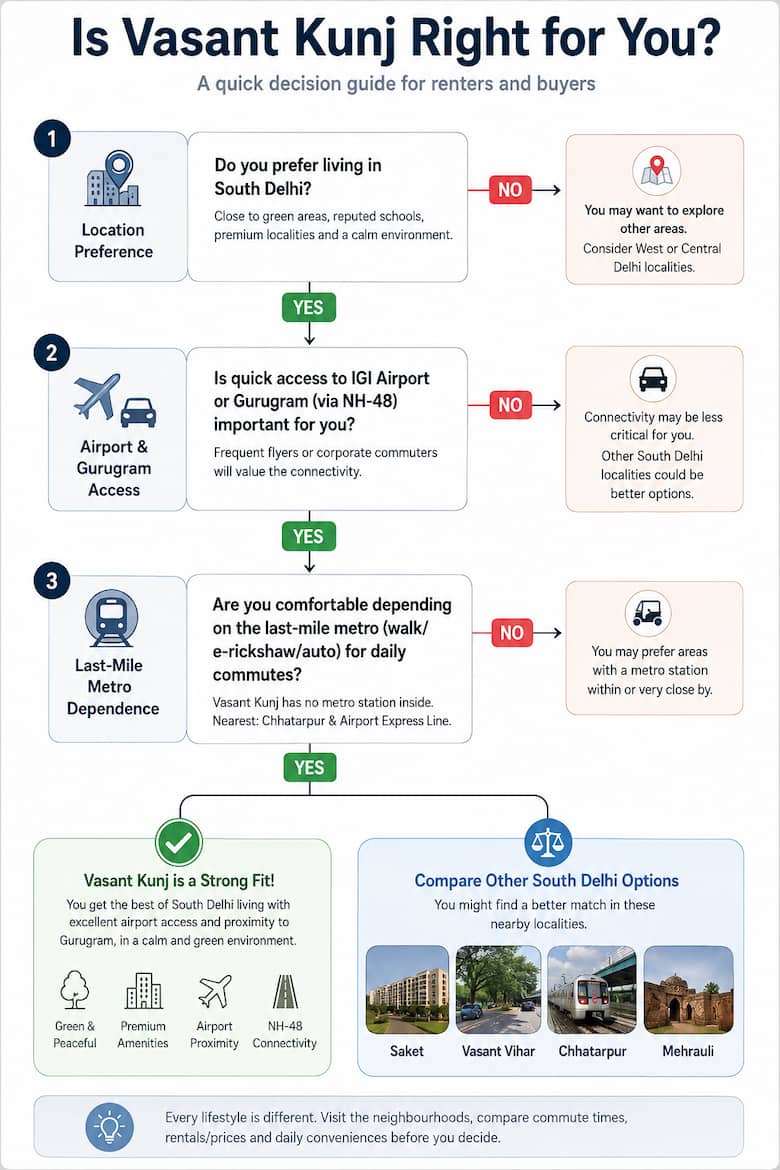
Vasant Kunj makes sense if airport access, Gurugram connectivity, and space are genuinely your top priorities, and if you are comfortable driving or using cabs for most daily movement, including your metro trips for now. It is particularly suitable for families who want strong schools and healthcare without leaving the locality, and for professionals whose work regularly takes them toward the airport or Gurugram’s NH-48 corridor.
Think twice if a metro station within walking distance is non-negotiable for you today, if your work or life centres on Central Delhi, or if you are working to a tight rental budget that a locality like Mehrauli or parts of Chhatarpur would serve better. The biggest trade-off, and the one every other consideration in this guide ultimately traces back to, is this: Vasant Kunj offers space, planning quality and airport-and-Gurugram access in exchange for a real, current dependence on private transport that will only ease once the Golden Line opens, on a timeline that is progressing but not yet confirmed.
The right decision, as with any South Delhi locality, depends less on Vasant Kunj as a whole and more on the specific sector, the specific society, your commute pattern, and your budget. Sector C for schools and a quieter, institutional feel, Sector B for the strongest resale profile, and the farmhouse belt for space at a different price point entirely, are three very different versions of the same locality name.