
📍 Ground Reality Guide — Last verified: May 2026 · Based on on-ground research across Mehrauli's wards, lanes, and residential pockets.

Written by: Website Admin
South Delhi Rental Expert · 5+ years on-ground experience

Quick Verdict: Is Mehrauli Worth Renting?
Yes — but only if you choose the right pocket. Mehrauli offers better space per rupee than most South Delhi areas. But inner lanes have real parking, sunlight, and access problems. This guide tells you exactly which pockets work and which to avoid.
This guide was prepared through direct on-ground visits to Mehrauli’s major wards and colonies. Information covers parking availability, road widths, water supply patterns, and tenant feedback collected across multiple visits in 2025–26. Data is verified periodically and updated when ground conditions change.
Quick Overview
Before we go deeper, let’s first give you a quick and practical introduction to Mehrauli. This will help you understand the area easily.
Mehrauli is not one single uniform locality. It is divided into many zones, lanes, and residential pockets. To make it easy to understand, we have broken it down into a simple structure — wards and colonies. This will give you clear ground-level knowledge about which area fits where and how the living experience changes from one place to another.
Some major residential colonies in Mehrauli are: Ram Colony (also called Islam Colony), Christian Colony (near the Bus Terminal), Brijwasi Colony, Khandsa Colony, and Garhwal Colony. These are not just names. Each colony has its own different density, space availability, and living conditions. Apart from these, there are many internal lanes and small residential pockets that together make up Mehrauli’s housing.
At the administrative level, Mehrauli includes Ward No. 1, Ward No. 2, Ward No. 3, Ward No. 4, Ward No. 6, Ward No. 7, and Ward No. 8. All the colonies and internal areas mentioned above fall inside these wards. Because of this, Mehrauli’s structure is quite spread out, and the living experience can be very different even within the same locality.
Mehrauli has multiple practical entry points and connectivity routes from different directions. The main entry is from the Andheria Mor side through Kalka Das Marg. Another important entry is from the Qutub Minar side, which also joins Kalka Das Marg and has the Mehrauli Bus Terminal. For metro connectivity, the Dadwari Road route connects directly with Qutub Metro Station and is considered more convenient. There is also an entry from the Garhwal Colony side, which connects to the Vasant Kunj–Munirka road corridor. You can also enter from the Kishangarh side, which connects to Vasant Kunj and Mahipalpur.
If we look at nearby connected areas, several important localities around Mehrauli directly affect renting options. The closest area for metro connectivity is Dr Ambedkar Colony, located right opposite MG Road near Chhattarpur Metro Station. Other important nearby pockets are Chhattarpur Hills and Chhattarpur Enclave Phase 1 & 2, which connect to Qutub Metro Station through 100 Feet Road.
Kishangarh is another area that is physically attached to Mehrauli. In many official cases, it is considered part of Mehrauli, especially for administrative and election purposes. But from a living perspective, people treat it as a separate identity. Similarly, Lado Sarai is an outer connected pocket of Mehrauli. It comes under Mehrauli for voting and administrative purposes, but due to distance and lifestyle differences, it is seen as a separate residential zone.
Vasant Kunj is a premium residential area right next to Mehrauli. It is well connected, but it belongs to a completely different category in terms of living standards and planning.
Overall, Mehrauli and all its surrounding areas form one connected ecosystem. However, each pocket has its own real estate value, livability, and tenant experience.
Approximate Rent Ranges in Mehrauli (2026)
| Pocket / Area | 1 BHK | 2 BHK | Best for |
|---|---|---|---|
| Ward 8 / Royale Greens belt | ₹14,000–20,000 | ₹22,000–32,000 | Families, car owners |
| Desu Road / Ward 7 | ₹12,000–18,000 | ₹18,000–26,000 | WFH, families |
| Islam Colony outer side | ₹10,000–15,000 | ₹16,000–22,000 | Budget families |
| Inner Ward 2, 3 lanes | ₹7,000–12,000 | ₹12,000–17,000 | Budget bachelors only |
Mehrauli vs Nearby Areas — Quick Comparison
| Factor | Mehrauli | Chhattarpur | Vasant Kunj | Saket |
|---|---|---|---|---|
| 1BHK rent range | ₹7K–20K | ₹8K–18K | ₹18K–35K | ₹20K–40K |
| Metro access | Good | Very good | Limited | Very good |
| Parking ease | Difficult | Moderate | Easy | Easy |
| Road quality | Mixed | Mixed | Good | Very good |
| Best for | Budget + space | Budget + metro | Families | Premium |
*Approximate comparison based on 2025–26 South Delhi rental market.
Facilities in Mehrauli
Mehrauli is generally considered a well-connected area in terms of facilities. But since this guide is written for people looking for rent, we are telling you the ground reality so you can make a practical decision.
When it comes to health facilities, Mehrauli has decent options for emergency and basic medical needs. Bhagwati Hospital is a private hospital that provides 24×7 emergency services and admission. Apart from this, there is also an MCD government hospital near Mehrauli Bus Terminal for basic government healthcare. Many local private clinics are also available that handle day-to-day medical problems.
For advanced medical treatment, you have good access to major hospitals nearby. Madan Mohan Malviya Hospital in Malviya Nagar is about 4 km away. Premium hospitals like Max Hospital in Saket and Fortis Hospital on the Kishangarh side are just 10–15 minutes drive away.
Mehrauli is also an established residential area for education. There are multiple MCD primary schools spread across different pockets, such as Daraganj side, Kalu Ram Chowk, near Pani Ki Tanki, and Ward 2 area. For senior secondary education, there are government boys and girls schools located near Qutub Minar, Police Station area, and Desu Road.
Private schooling options in Mehrauli are also good and varied. CBSE schools like Prince Public School, St. John’s Public School, Saraswati Bal Mandir School, and Baba Banda Singh Bahadur School are available here. There are also other local private schools that provide education from primary to senior secondary level. Nearby areas have many reputed schools, which gives families more education options.
In terms of connectivity, Mehrauli has a strong location. It has multiple entry and exit routes that directly connect to major roads. This makes it easy to reach important routes like MG Road, MB Road, Aruna Asaf Ali Road, Vasant Kunj–Mahipalpur corridor, and Safdarjung side in short travel time.
For public transport, Mehrauli has its own Bus Terminal from where you can get regular buses to different parts of Delhi. Metro connectivity is also practical. Two major Yellow Line stations — Qutub Minar Metro Station and Chhattarpur Metro Station — are easily accessible from Mehrauli. This makes commuting to Gurgaon and Central Delhi quite convenient. In the future, there is also a proposed network upgrade at Chhattarpur Metro Station, which will further improve connectivity.
Overall, Mehrauli offers a decent mix of connectivity and basic-to-advanced facilities. However, the actual living experience always depends on the specific pocket and location you choose.
What is Living in Mehrauli Delhi Actually Like?
Now that you have understood the basic structure, connectivity, and surrounding areas of Mehrauli, the next important step is to know how real life actually feels here. Because judging Mehrauli only by looking at maps or facilities is not practical.
Mehrauli does not follow any one fixed pattern. It is an area where every pocket, every lane, and every building cluster can feel very different. That is why making one overall impression about Mehrauli is often misleading.
So, Mehrauli is to not treat it as one uniform locality:
- Mehrauli is not a uniform residential area
- Every colony and ward has a different living experience
- Asking “Is Mehrauli good or bad?” is itself a misleading question
- The reality always depends on micro-location, building type, and access road
These three factors decide whether your daily living experience will be comfortable or challenging.
That is why in the coming sections, we will break down Mehrauli with this practical view. So you get real decision clarity, not just general information.
Real Framework for Judging Mehrauli (From a Tenant’s Point of View)
To properly understand Mehrauli, just comparing location and rent is not enough. The real decision comes when you look at the practical factors of daily living.
That is why the right way to judge Mehrauli is to see it through a tenant’s lens. This means focusing on the core things that directly affect your everyday rental life.
Space & Livability
Short answer: Space is decent but depends heavily on pocket and floor. Outer-lane upper floor flats are significantly better than inner-lane ground floor units.
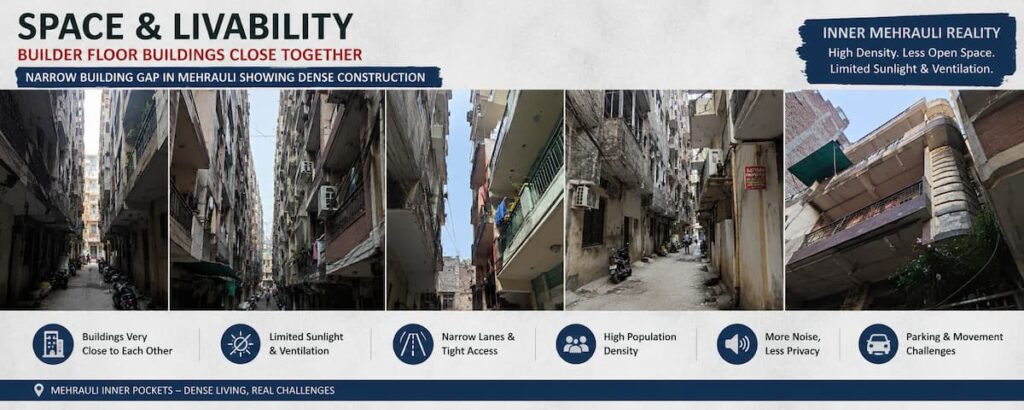
To properly understand space and livability in Mehrauli, it is important to know its historic and unplanned development pattern. This area was not designed like a modern planned township. Because of this, plots and buildings here are quite uneven and developed organically over time.
Today, most houses in Mehrauli are builder floors and independent houses. These were built gradually according to the available land. You can find flats ranging from about 450 sqft to 1500–1800 sqft. But the actual living experience does not depend only on size.
Due to high population density, a lot of housing units have been built in limited space. This makes the overall area feel compact. Most buildings are 3–4 floors high, though some places have 5–7 floor buildings too.
The main issue in Mehrauli is not the lack of space, but the close proximity of buildings and poor layout. In many pockets, buildings are constructed very close to each other. This reduces privacy and openness. In such cases, people often have to put grills or coverings on balconies because the distance between buildings is very less.
The narrow lanes and internal roads also show this unplanned development. In many areas, the lanes are so narrow that daily movement feels restricted. Sometimes even vehicles have to pass with difficulty.
Because of this compact structure, sunlight and ventilation are also uneven. In dense inner pockets, lower floors get very little natural light. In some narrow lanes, sunlight is almost negligible.
Some outer areas and newer developed zones are better. For example, Desu Road belt, some new pockets in Ward 8, road-facing lanes in Islam Colony, and peripheral sections near Andheria Mor have better ventilation and spacing. A few modern apartment complexes, especially park-facing ones, also offer better livability.
The simple ground reality is this: In Mehrauli, the difference between “decent space” and “bad space” does not depend on the colony name. It depends on building spacing, lane width, and road connectivity. Properties on main roads or better-planned sub-roads generally offer better living experience. In contrast, interior dense lanes can feel very different even at the same rent. Most housing in Mehrauli consists of builder floors — independently constructed 1–4 floor units built on individual plots over time.
Connectivity Reality
Short answer: Metro connectivity is practical. Both Qutub Minar and Chhattarpur Yellow Line stations are reachable. Most residents prefer Chhattarpur metro, especially at night.
Mehrauli’s connectivity cannot be fully understood just by looking at a map and seeing it as “well connected” or “central location.” The real experience depends on actual road usage, traffic patterns, and micro-routes.
The main road in Mehrauli is Kalka Das Marg. It acts as the backbone for daily movement and connects Mehrauli to MG Road and the Chhattarpur–Andheria Mor corridor.
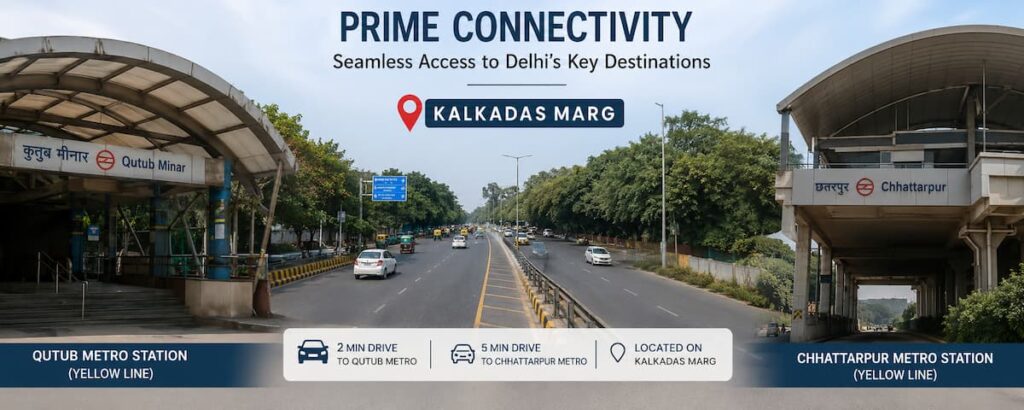
Metro connectivity is available at two stations — Qutub Minar and Chhattarpur. But most people prefer Chhattarpur Metro Station, especially in the evening and at night. The reason is that the road near Qutub Minar feels more isolated and has less traffic and street activity after dark. This makes the Chhattarpur side more practical and commonly used.
During peak hours, traffic in Mehrauli becomes very route-specific. If you are going towards Central Delhi, the Qutub Minar side gets very congested, especially near the Bus Terminal where there are many signals and junctions close together. Areas around Lado Sarai and TB Hospital also cause frequent delays, making travel time unpredictable.
Gurgaon connectivity depends on the Andheria Mor route. The lack of a smooth direct crossing creates problems. You often have to take a U-turn from the Qutub Minar side and cross multiple signals, which makes movement slow and stop-and-go during peak hours. Local market activity and roadside parking on Kalka Das Marg also cause frequent slowdowns.
Internal connectivity has its own reality. Moving from one pocket to another in Mehrauli may look easy on paper, but it can be confusing and require detours in real life. Autos go from main roads to sub-roads, but they often cannot enter narrow micro lanes. The “last 100 meter problem” is very common here.
Some specific zones are clearly avoided by cabs and autos. Points like Sarai Electronics Market, Sabji Mandi, Anaj Mandi, Canara Bank Chowk, and Kalu Ram Chowk are major congestion spots. Wrong parking and narrow entries make movement difficult for four-wheelers. These points also serve as entry gates for many internal colonies, so the pressure remains high.
Cab availability also depends on experience. Many drivers who have driven in Mehrauli’s congested areas often avoid repeat rides, especially during peak hours. New or more flexible drivers end up picking up more rides.
Navigation problems are also common because of narrow lanes and unmarked internal roads. In many cases, drivers have to ask local residents for directions because GPS is not reliable for the last mile.
The Bus Terminal is mostly used by people who depend on daily bus commutes and prefer not to use the metro. Buses to Central and South Delhi run frequently, and waiting time is usually less than 10 minutes. It is a functional but underutilized option.
Overall verdict: Mehrauli is well-connected from the outside, but internally it is highly experience-dependent. People who understand its network find movement easy and efficient. But for first-time users, the same system can feel chaotic and tiring.
Internal Roads & Mobility
Short answer: Main roads are fine. Inner lanes are narrow — bikes only in many pockets. Car owners should check last 200 meters before finalising any flat.
In Mehrauli, the real mobility problem is not because of just one thing. It is a combined effect of narrow lanes and unplanned road design.
Apart from Kalka Das Marg, almost every sub-road and internal lane has very short straight stretches. You rarely find a straight road longer than 100 meters. After that, there is usually a curve or a full turn. On top of this, most lanes are very narrow. In many places, when one car passes, there is barely enough space for a bike to pass safely.
In this situation, bikes become the most practical and efficient way to move around. You can go from one end of Mehrauli to the other in just 10–12 minutes on a bike. But the same distance can take 30–45 minutes by car, depending on traffic and time of day. This is why most people treat bikes as their “default survival vehicle” here.
Owning a car is practical only if you live on outer lanes or in more open pockets. Otherwise, daily travel becomes very stressful.
Another big issue is delivery and shifting. Very few sub-roads in Mehrauli allow big vehicles like trucks or loaders to enter. Because of this, people often use smaller vehicles for shifting houses. In many cases, manual carrying for the last 50–100 meters is unavoidable, especially in dense inner lanes. Roadside parking is also very common due to limited parking space, which further slows down movement.
Navigation inside Mehrauli is also inconsistent. GPS often doesn’t work well, and first-time visitors easily get confused because one colony can have many similar-looking lanes. Local guidance becomes very important in such cases.
Traffic behaviour follows a clear pattern — market spillover, school timings, roadside parking, and sudden bottlenecks are common problems. Areas around Kalka Das Marg and local markets stay congested due to loading-unloading, auto stands, and roadside shops. Movement is rarely smooth. It mostly follows a stop-and-go pattern.
Final ground reality: As population and residential density in Mehrauli keeps increasing, parking pressure is also rising continuously. Most houses have multiple vehicles, so road space is already full. Commercial activity and local markets add even more pressure, and the overall traffic load keeps growing every year.
.
Parking Situation
Short answer: Parking is the single biggest practical problem for car owners in Mehrauli. Two-wheelers are fine. Cars in inner lanes face daily stress.
In Mehrauli, parking is not just a convenience — it is a daily survival factor, especially if you own a vehicle. Before finalizing any rent, if a tenant should check one thing seriously, it is parking. Changing a flat is easy, but living with daily parking problems can be mentally exhausting.
First, you need to understand that the parking experience for two-wheelers and four-wheelers in Mehrauli is completely different.
For bike owners, the situation is manageable. Most apartments have some space for bikes on the ground floor or near the entrance. However, because there are so many vehicles, you will often see bikes parked outside on the lane. In dense colonies, roadside bike parking has become the normal system.
For car owners, the reality is much tougher. If you are not living on outer lanes or main/sub-road connected pockets, owning a car can become a source of stress. In inner lanes and last-mile areas, people either park their car on the road, use nearby public parking, or simply decide not to buy a car.
Public paid parking is available, but it offers only limited help. Monthly charges are usually between ₹1,500 to ₹3,000 (Based on local market survey, South Delhi, 2026), and because demand is high, space is not guaranteed. Private dedicated parking can be arranged but usually at higher cost and through personal contacts or local arrangements.
Night-time parking (especially between 7 PM and 10 PM) is the most stressful time in Mehrauli. As people return home, the pressure for roadside parking reaches its peak. Many areas have developed an informal “my spot” culture. People treat their usual parking spots as reserved, and arguments with new tenants or outsiders are quite common.
Roadside parking has become both a forced system and a choice. Many people prefer to park outside to avoid disputes inside the building. Owners usually get preference for parking, while tenants often have to compromise. In the rental market, “parking included” is often misleading. The spot that looks available during the visit can become disputed or unavailable after you move in.
Some roads have practically become permanent parking lanes, such as Aggarsen Vatika Road, Desu Road, and the stretch from Kalu Ram Chowk to Bus Terminal. Here, moving traffic and parked vehicles constantly block each other.
Parking problems do not stop at convenience. There is also a real risk of vehicle damage. Minor scratches, dents, and broken side mirrors are common complaints. Bike users also face issues like helmet theft, seat cover theft, rain damage, and blocked exits.
Emergency services are also affected. Narrow lanes with uncontrolled parking can make it difficult for ambulances and fire brigades to reach, and some delay incidents have been reported.
For visitors, the situation is even worse. Guest parking in inner lanes is almost non-existent. Visitors often have to park on the main road or far away open spots.
There are some parking-friendly exceptions. Outer edge developments and better-planned apartment areas — especially projects near Royale Greens and wider outer-road facing pockets — offer comparatively less stress.
Simple on-site test to judge parking: Check how many cars are already parked near the building, how easy it is to turn on the road, and whether there is any usable open space or alternate parking nearby. If these three look weak, parking problems are almost certain in the future.
Brutal truth: If you are not taking a flat on an outer lane in Mehrauli, you should think twice before owning a car.
Water & Basic Utilities
Short answer: No shortage issue. Delhi Jal Board supply plus borewell backup available. Main issue is building-level management — tank size and motor quality matters.
Before talking about water in Mehrauli, it is important to clear one common misunderstanding. The main issue here is not water shortage, but how well each building manages its water supply. From outside, it may look like water supply is the same everywhere, but the actual experience depends mostly on the building’s internal setup.
The main water supply comes from the Delhi Jal Board. It covers most areas of Mehrauli. Delhi Jal Board water usually comes 2–3 times a week. When it comes, it arrives with good pressure — sometimes so strong that water flows on the roads and you don’t even need to run the motor.
To fill the gaps, most areas also use borewell water. This supply runs daily or on alternate days for a limited time. Tanker water is not very common and is usually needed only in peak summer or emergencies.
The ground reality is that water experience in Mehrauli depends more on the building than on the area. An average building has 8 to 20 flats. In overcrowded buildings, water pressure becomes a big challenge. Problems usually start from the 2nd floor onwards, especially in buildings with 5–7 floors. Top floors often face low pressure, delayed supply, and rooftop tanks getting empty quickly.
The motor system is also very important. Some buildings have one common motor, while others have separate arrangements. In many cases, tenants have to manage the motor themselves. If the motor is weak or poorly maintained, you will face water issues even when supply is available.
Residents can clearly notice differences in water quality. Delhi Jal Board water sometimes has a smell of treatment chemicals. Borewell water has a different taste and smell. Most people use RO for drinking, but the water is generally fine for bathing and washing. Severe hard water problems like stains or blockages are not very common here.
In summer, water pressure naturally drops a little because demand increases. Extreme shortages are rare, but good storage and distribution in the building become more important. That is why some careful residents keep extra buckets or drums for emergencies, especially on top floors.
A common mistake tenants make is checking only the taps and washroom while seeing the flat. More important things to check are: size of the rooftop tank, total number of flats in the building, how frequently water comes, and how well pressure reaches the upper floors.
Brutal truth: In Mehrauli, the water issue is usually not “Is there water or not?” It is more about “How efficiently does your building manage the water it gets?”
The Hidden Truth About Mehrauli – Not Every Pocket is the Same
The most important thing to understand about Mehrauli is that it is not one uniform residential area. Just seeing the name “Mehrauli” and assuming everything is the same can be very misleading. The living experience here can change completely from one pocket to another — even from one building to another. Sometimes two flats in the same budget can offer totally opposite daily experiences.
Broadly, Mehrauli can be divided into several practical categories: old dense settlements, main road properties, sub-road apartments, outer-edge premium pockets, newly developed apartment clusters, and hidden interior village-style lanes. Each category has its own level of comfort, accessibility, and compromises.
The most challenging areas are usually the core old settlement pockets. These include internal lanes behind the old market, areas near Sabzi Mandi (like Doodh Wali Gali, Chhoti Sabzi Mandi, Ready-Made Gali, and inner lanes of Ward No. 3), the old Punjabi Mohalla near Sarai Electronics Market, the interior area behind the Bus Terminal near Dargah, and lanes inside Kalu Ram Chowk. In these pockets, the problem is not just narrow lanes — the overall openness and movement feel very limited. In many places, you may have to walk the last stretch to reach your house, and the environment can feel dark and congested even during the day.
On the other hand, some pockets in Mehrauli offer genuinely better living experiences — and these are the hidden differences that most tenants miss.
Desu Road is one strong example, where many societies and apartment clusters feel comparatively spacious. Ward No. 8’s newly developed colonies are also much better planned, with wider roads and direct connectivity to Kalka Das Marg. Outer-side properties in Islam Colony (Ram Colony), especially road-facing buildings and sub-roads near Shamsi Talab Road, offer a surprisingly good balance of space and access.
On the premium side, the Andheria Mor edge and Royale Greens belt are among Mehrauli’s best residential pockets. Royale Greens and nearby apartment clusters offer a more planned, spacious, and parking-friendly environment — which feels very different from Mehrauli’s traditional dense areas. Societies like Makhdoom Shah Colony and Amaryllis Apartment in this zone are also considered better-quality options.
One more important thing to note: Even inside the same colony, the reality can change dramatically. For example, in Ward No. 8, you can find older flats behind the Electronics Market in the ₹15,000–₹20,000 range, but you may have to walk through narrow lanes and the environment feels dark and congested. In the same budget, newly constructed apartments on outer lanes (like Maruti Apartment or Brijwasi Colony side) can give better roads, sunlight, and easy access.
Similarly, in Ward No. 2, the difference depends on road width. Apartments on minimum 10-feet-wide roads feel much more comfortable, while thinner lanes reduce convenience noticeably. Mehta Chowk also has some good options on outer-access buildings, while inner 4–5 feet lanes create practical challenges. The Mehrauli to Gaushala Road belt is also relatively better because of wider lanes and stronger connectivity towards Vasant Kunj.
Border zones have clear advantages. Areas towards Chhattarpur side, Vasant Kunj side, Kishangarh side, Lado Sarai side, and Andheria Mor edge generally feel better. Roads are wider, it’s easier to exit the area, and you get more new developments. In comparison, inner pockets of Ward No. 3, Ward No. 4, and Ward No. 2 need to be evaluated more carefully.
There are also some underrated pockets in Mehrauli that outsiders rarely know about, but locals prefer. These include gated RWA societies on Desu Road, Kalka Apartments belt opposite Shamsi Talab (with park-facing lanes, direct sunlight, and green surroundings), and gated societies near Gaushala Road towards Vasant Kunj. These are hidden better-quality options that are easily missed in general searches.
Final Conclusion: In Mehrauli, it is not the colony or ward name that decides your life — it is the specific society, building, and its exact connectivity.
You can get completely different living experiences in the same rent. If you decide only by colony name, the risk of choosing the wrong pocket is very high.
Which Type of Tenants is Mehrauli Suitable For?
Short answer: Bachelors — easy. Budget families — good if right pocket. Car-dependent professionals — difficult. Premium seekers — wrong area.
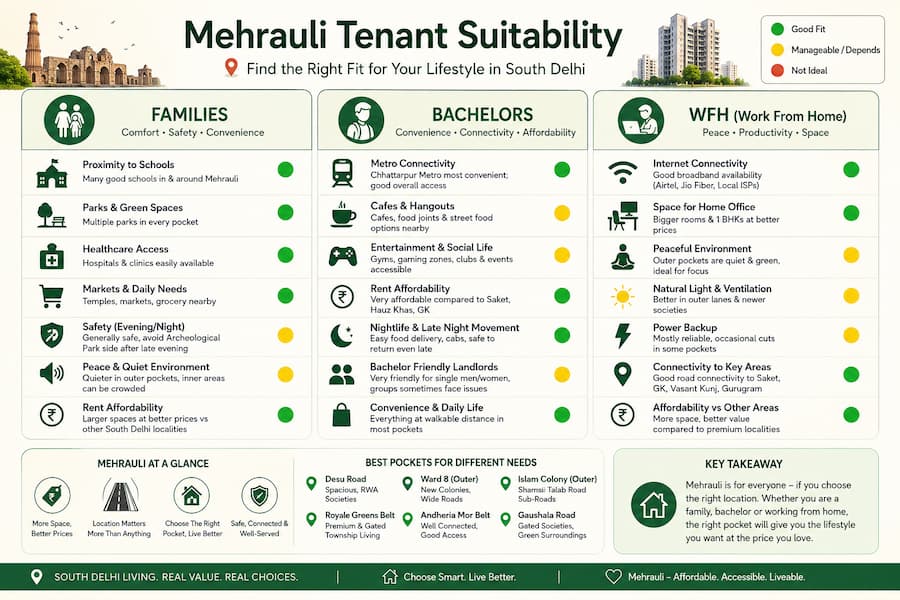
Mehrauli does not give the same experience to every tenant. It is one of those rare South Delhi locations where it can be perfect for one person and frustrating for another. Suitability here does not depend only on budget — it depends on your personal priorities: space, commute, family comfort, peace, or flexibility.
If you choose Mehrauli with the right expectations, it can be one of the best value-for-money rental markets in South Delhi. But if your priorities don’t match the locality, you may start feeling daily inconveniences quickly.
If you prioritize space If the most important thing for you is flat size and usable living space, then Mehrauli can be a strong option. You can find good bedroom size, living room, balcony, storage, and overall square footage — especially when you compare it with premium areas like Saket.
Interestingly, even though people think otherwise, the average 1BHK in Saket may be slightly bigger than in Mehrauli, but because of rent per square foot, Mehrauli offers much better value. Roughly, Mehrauli is about ₹8 per sq. ft. cheaper. This means for the same size flat, you will pay noticeably lower rent in Mehrauli.
However, there is a catch: Getting more space does not automatically mean better living experience. If you pick a random flat without proper checking, you may have to compromise on parking, sunlight, access road, privacy, and sometimes even lift.
If you are a “space-first” tenant — like WFH couples, small families, students, or pet owners — Mehrauli can be quite suitable for you, especially in outer belts and newly developed pockets. Green belts and park-facing areas give extra advantage for families with kids or pets.
If daily commute is important Mehrauli can be quite practical for commuting — but only if you choose the right pocket.
It is most convenient for people who travel to Gurgaon daily. Thanks to Chhattarpur Metro and MG Road connectivity, the daily travel becomes manageable. Commute to Central Delhi and Saket is also relatively practical. Hauz Khas is workable, but regular commuting to Noida is generally not ideal.
For metro-dependent tenants, areas like Ward No. 8, Khandsa Colony, Andheria Mor belt, Ward No. 6, Dargah area, and Aulia Masjid side are good practical options.
If you travel by car, you need to choose the location even more carefully. Andheria Mor belt, Desu Road, Ward 1, Christian Colony, and Kishangarh-connected areas feel better. If you live in inner Mehrauli and take out your car during peak hours, daily travel can become mentally exhausting.
Simple Rule: If peace and smooth daily commute are more important to you than budget, then Mehrauli may not be the best fit.
If you are a family Mehrauli can surprisingly be a strong option for families — especially when both affordability and practical convenience matter.
School access is good, daily market access is excellent, and the temple/community environment is quite active. Medical support is decent, and because the area is crowded, it does not feel isolated.
Biggest Positives for Families:
- Temple and market access almost unmatched
- Strong network of schools
- Relatively affordable family-sized flats
- Established local community feel
Compromises:
- Narrow lanes
- Parking stress
- Daily noise
- Crowd
For families with kids, better choices are Khandsa Colony, Desu Road, Ward 6, Ward 8, Ward 1, Ward 2, and Andheria Mor belt — especially pockets near parks or green areas.
Overall, Mehrauli feels reasonably safe for women because the area remains active and populated. It is better to avoid quieter stretches near Mehrauli Archaeological Park in the evening or late night.
If you are a bachelor – Mehrauli is one of the most affordable rent options in South Delhi for bachelors — bigger rooms, metro access, and flexible landlords..
Cheaper rents, bigger rooms, metro access, and relatively liberal rental acceptance — all these things work in favor of bachelors. Landlords are generally friendly with both single men and single women, especially in newer societies. However, in old dense pockets, there may be some hesitation for group tenants.
Late-night movement is also easy. Food delivery, cabs, and midnight returns usually don’t create issues. Police booths and active local movement also give a sense of security.
The biggest hidden issue for bachelors is that some homeowners in dense old areas avoid bachelor tenants, while newer societies have fewer such concerns.
Final Verdict: Who is Mehrauli Best For?
The brutally honest answer is: Mehrauli can work for almost every type of tenant — but choosing the right pocket is mandatory.
It is especially best suited for people who:
- Are budget-conscious
- Want good manageable space
- Want to live in South Delhi without paying premium prices
- Can tolerate some crowd and imperfect infrastructure
- Want to understand the locality before deciding
If you want luxury-level peace, perfect road planning, and effortless parking, then Mehrauli is not ideal.
But if you want value, connectivity, flexibility, and practical South Delhi living — Mehrauli is a strong contender.
Ready to Find a Flat in Mehrauli?
Browse verified flats — filter by ward, road type, and budget. See all available flats for rent in Mehrauli.
When to Say “NO” to Mehrauli (Deal Breakers)
Mehrauli can be an excellent value-for-money rental market for many people, but it is not suitable for everyone. The area naturally demands some compromises. If your priorities do not match these compromises, it is better to avoid Mehrauli from the beginning.
Biggest Deal Breakers:
1. Parking If dedicated car parking is a must for you and you expect easy parking inside the building or right in front of the house, then most pockets in Mehrauli can be frustrating. Except for premium gated societies and some outer belts, parking is mostly an adjustment-based system. Owners and tenants often share the same parking, roadside parking becomes a forced choice, and finding an empty spot at night can become daily stress. If you are taking a flat in inner Mehrauli and own a car, do not take this lightly.
2. Wide Roads & Smooth Access If you want easy entry-exit, good turning radius, and smooth movement every day, then Mehrauli’s internal pockets may not suit you. Except for Kalka Das Marg and some outer sub-roads, most roads are not properly planned. Curved lanes, narrow roads, and stop-start movement are normal here. If driving comfort is a high priority for you, this can turn into daily irritation.
3. Predictable Building Management In Mehrauli, water issues are usually not about shortage but about building-level management. If you want a hassle-free rental life where you never have to worry about motors, rooftop tanks, floor pressure, or number of flats in the building, then not every building will suit you. Especially in overcrowded apartments, low pressure on top floors and fast-emptying tanks are common problems.
4. Modern Gated Society Lifestyle If you expect planned internal roads, basement parking, visitor parking, controlled entry, and organized infrastructure, then you need to choose very carefully in Mehrauli. Such options do exist (especially in Royale Greens belt, some RWA societies on Desu Road, and newer apartment clusters), but overall Mehrauli is dominated by traditional builder-floor living.
5. Frequent Cab Use & Visitors If you use cabs daily, have regular guests, or need direct doorstep delivery, some internal pockets can feel inconvenient. In many micro-lanes, cabs avoid entering, GPS gets confused, and visitors may have to walk from the main road.
Brutally Honest Rule: If you want smooth, silent, and highly organized urban living and your budget is flexible, then Mehrauli is probably not the right choice for you.
Smart Decision Rules for Mehrauli
The biggest mistake people make is finalizing a flat just by looking at the colony name or rent. Smart decision-making in Mehrauli means understanding the exact pocket, not just the flat.
Key Rules:
- Rule 1: Don’t trust the colony name. The difference between outer lane and inner lane in the same colony can be dramatic.
- Rule 2: Don’t just see the flat — check the route to reach the flat. Many flats look decent inside but have difficult access through narrow lanes and parked vehicles.
- Rule 3: Always visit during peak hours (morning school time or evening 7–9 PM). This is when you see the real character of the area.
- Rule 4: First verify water supply and parking. Ask about rooftop tank size, number of flats in the building, and check parking availability yourself at night.
- Rule 5: Personally check main road access and sub-road width. Bike and car experience in Mehrauli is completely different.
The smartest tenants are those who judge the location properly before renting. In the same budget, you can get completely different quality of life — your selection method matters the most.
Best Areas to Rent in Mehrauli – Pocket-wise Comparison
| Pocket / Area | Best For | Pros | Cons | Recommendation |
|---|---|---|---|---|
| Royale Greens & Andheria Mor Edge | Families, Car Owners, Premium Feel | Spacious, Better parking, Modern apartments, Good connectivity | Slightly higher rent | ★★★★★ Highly Recommended |
| Desu Road Belt | Families, WFH Professionals | Wider roads, Good sunlight, Decent parking, Peaceful | Limited options | ★★★★☆ Excellent |
| Ward 8 (Newer Colonies) | Families & Couples | Better planned, Wider lanes, Good access | Some parts still developing | ★★★★☆ Strong Choice |
| Islam Colony Outer Side | Budget Families, Space Seekers | Good space, Road access, Balanced living | Inner lanes can be congested | ★★★★ Recommended |
| Shamsi Talab Road & Gaushala Road | Families & Bachelors | Park-facing options, Better ventilation, Connectivity | Variable quality | ★★★★ Recommended |
| Khandsa Colony | Families | Community feel, Schools nearby, Affordable | Some narrow internal lanes | ★★★☆ Good |
| Christian Colony (Near Bus Terminal) | Bachelors & Small Families | Metro access, Market nearby | Can be noisy, Parking pressure | ★★★ Average-Good |
| Inner Ward 2, 3 & Old Market Lanes | Only Budget Bachelors | Very cheap rent | Narrow lanes, Poor parking, Low sunlight, Congestion | ★ Avoid for families |
Found your pocket? Browse available flats for rent in Mehrauli → https://southdelhirentwala.com/listing-areas/flats-for-rent-in-mehrauli/
Mehrauli Rental Decision Quick Checklist: What to Check for a Better Living Experience
1. Choose an Outer Lane or Main Access Road
The single biggest quality difference in Mehrauli comes from outer-lane vs inner-lane location. Flats on outer lanes usually offer better road access, easier cab movement, more sunlight, and less daily congestion.
2. Prefer Wider Roads (Minimum 10 Feet)
Road width directly affects comfort. Buildings on 10-feet or wider roads feel significantly more practical for walking, deliveries, bike movement, and emergency access.
3. Prioritize Better Parking Potential
If you own a car, focus on pockets where parking is less stressful—especially Royale Greens, Andheria Mor edge, Desu Road, and select Ward 8 pockets. Inner Mehrauli can create daily parking frustration.
4. Check Building Water Management, Not Just Water Supply
Mehrauli generally has reliable water through Delhi Jal Board + borewell backup. The real difference comes from tank capacity, motor quality, and upper-floor water pressure.
5. Look for Newer Apartment Clusters
Newer constructions in Ward 8, Royale Greens belt, and selected gated societies on Desu Road usually offer better ventilation, modern layouts, and fewer maintenance issues.
6. Choose Pockets with Better Sunlight and Ventilation
Many inner buildings suffer from limited natural light due to narrow building gaps. Outer-facing flats and park-facing pockets near Shamsi Talab Road and Gaushala Road often provide a better living environment.
7. Prefer Strong Metro and Gurgaon Connectivity
For daily commuters, pockets closer to Chhattarpur Metro, Andheria Mor, and Kalka Das Marg access routes offer more practical travel—especially for Gurgaon-bound professionals.
8. Match the Pocket to Your Tenant Type
Mehrauli suits different tenants differently:
- Families: Desu Road, Ward 8, Khandsa Colony
- Bachelors: Christian Colony, metro-connected pockets
- WFH tenants: outer belts with better light and quieter surroundings
9. Verify the Last 100-Meter Access
A flat may look good inside, but the final approach road can change daily experience completely. Always check how easy it is to reach the building on foot, by bike, and by car.
10. Judge the Exact Building, Not Just “Mehrauli”
In Mehrauli, two flats with the same rent can offer completely different lifestyles. Society quality, road type, building density, and immediate surroundings matter more than the colony name itself.
Final Reality Check – Mehrauli Verdict
Final Verdict:
- Correct pocket selection = Highly workable and practical South Delhi living.
- Wrong assumption = Daily friction that slowly becomes exhausting.
Mehrauli is not for everyone.
But for those tenants who understand the area and choose wisely, it can be surprisingly rewarding.
How This Guide Was Made
This guide was prepared through direct on-ground visits to Mehrauli’s major wards and colonies. Information covers parking availability, road widths, water supply patterns, and tenant feedback collected across multiple visits in 2025–26. Data is verified periodically and updated when ground conditions change.
Frequently Asked Questions About Renting in Mehrauli
-
Is Mehrauli a good location for renting?
Mehrauli is a practical and affordable rental location overall, but it does not offer the same experience to every tenant. If you are budget-conscious, want comparatively larger space in South Delhi, and can accept a traditional mixed-density area, then Mehrauli can be quite suitable. However, if you expect planned roads, guaranteed parking, and premium society-style living, you will need to choose the pocket very carefully.
-
Which areas in Mehrauli are better for renting?
Outer-edge and newly developed pockets are generally considered better. Areas like Desu Road, newer apartment belts in Ward 8, outer side of Islam Colony, sub-roads near Shamsi Talab Road, Royale Greens belt, Andheria Mor edge, and gated apartment clusters near Gaushala Road offer comparatively better access, wider roads, and less parking stress. Inner parts of Ward 2, Ward 3, Ward 4, and dense lanes connected to the old market can have more compromises.
-
Is parking a serious problem in Mehrauli?
Yes, especially if you own a four-wheeler. Two-wheeler parking is manageable, but car parking is one of the biggest practical challenges in Mehrauli. Many buildings advertise “parking included,” but in reality it is often shared or leads to disputes. In inner lanes, roadside parking is a forced reality. If stress-free guaranteed parking is mandatory for you, only consider outer lanes or premium apartment societies.
-
Is there a water supply issue in Mehrauli?
There is generally no major water shortage. Both Delhi Jal Board supply and borewell support are available, so overall supply is decent. The real issue is usually building management — how many flats share one tank, how good the motor system is, and how well pressure reaches upper floors. Low pressure and timing issues are common on top floors (especially above the 3rd floor).
-
Is metro connectivity practical in Mehrauli?
Yes, and it is quite strong. Both Qutub Minar and Chhattarpur Yellow Line stations are accessible. However, most people prefer Chhattarpur Metro Station, especially in the evening and at night, because the route feels safer and more active. The Qutub Minar side road feels quieter and less preferred, especially for women commuters after sunset.
-
Is Mehrauli suitable for families?
Mostly yes. Schools, markets, temples, and medical access are strong, which supports family living. Safety is also generally acceptable. Families will get the best experience if they choose pockets with wider roads and better access. Narrow lanes, dense inner areas, and heavy parking zones can create daily frustration for families.
-
Do bachelors get flats easily in Mehrauli?
Yes, and quite easily. Mehrauli is bachelor-friendly, especially in new apartment buildings and outer pockets. Both single men and single women get flats without much difficulty. However, there may be some restrictions for group tenants in older, dense residential pockets where local homeowners can be selective.
-
Is there a problem with sunlight and ventilation inside flats in Mehrauli?
Yes, this is a very common issue — especially in inner lanes and old dense settlements. Because most buildings are constructed very close to each other, balconies are often covered with iron grills and natural light is limited. In some micro-lanes, direct sunlight does not reach for years. Better ventilation is mostly available in outer-road facing apartments and newer society belts.
-
Is it practical to live in Mehrauli with a car?
Only in selective pockets. It is manageable if you choose outer lanes, main roads, or apartments on wider sub-roads. But in inner Mehrauli, car ownership can become daily stress due to parking, blocked exits, scratches, narrow turns, and peak-hour movement. Honest advice: Always verify the parking reality before finalizing the flat.
-
What should I check before finalizing a flat in Mehrauli?
Just seeing the flat is not enough. Make sure you verify these 5 important things:
1. How many cars are already parked near the building
2. What is the last 100-meter access like to reach the flat
3. How is the traffic and parking pressure during peak hours
4. Total number of flats in the building and water storage capacity
5. Whether the flat is on an outer lane or deep inside an inner laneIn Mehrauli, your living experience depends more on the exact building, access road, and surrounding density than just the colony or ward name.
-
Is Mehrauli safe for single women tenants?
Generally yes in outer pockets and main road-facing buildings. Ward 8, Desu Road, and Royale Greens belt are considered comfortable for single women. Inner lanes near the old market area are less preferred due to narrow streets and crowding at night.
-
How far is Mehrauli from Cyber City Gurugram?
Approximately 12–18 km depending on route. By metro: Chhattarpur → Huda City Centre, then auto or bus to Cyber City — total 45–60 minutes. By car via NH-48: 25–40 minutes depending on traffic. Mehrauli is one of the better South Delhi options for Gurgaon commuters on a budget.
-
Are furnished flats available in Mehrauli?
Yes, semi-furnished and fully furnished flats are available, especially in newer apartment buildings in Ward 8 and Royale Greens belt. Builder floors in inner areas are mostly unfurnished or basic semi-furnished. Expect ₹3,000–8,000 extra per month for furnished units.
-
What is the notice period for renting in Mehrauli?
Standard notice period is 1 month in most Mehrauli rentals. Some landlords in inner lanes accept 15 days. Security deposit is typically 2 months rent. Always get a registered rent agreement — avoid verbal agreements.
-
Is Mehrauli good for people working from home?
Yes, with the right pocket. Outer lane flats have better natural light and ventilation — important for WFH comfort. Internet connectivity is good — JioFiber, ACT Fibernet, and Airtel broadband all available. Avoid inner lanes where noise and limited light affect daytime work quality.
Note: Ground conditions in Mehrauli change frequently. Always verify parking, water supply, and access road personally before finalising any rental. This guide provides general area-level information only.